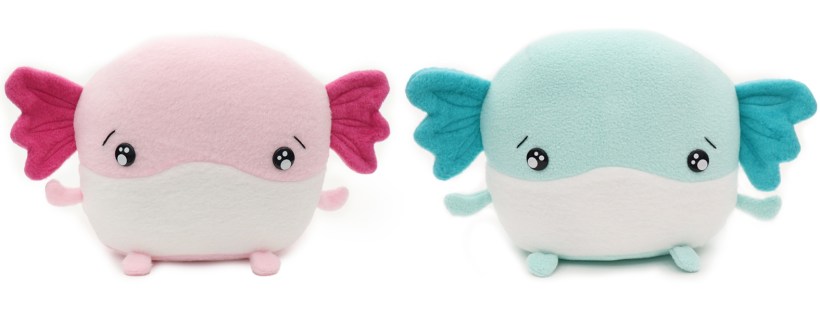
I am happy to finally have the chance to make another post. Today, I have a cute little plush for you. It’s a project my students have been requesting for a while, and is an adorable axolotl plush.
It’s a pretty simple plush and doesn’t require a lot of fabric. The trickiest part is cutting out the pieces, as some of the pattern pieces include seam allowance, while others don’t. However, those that don’t are much easier to sew before cutting, so I opted to use the differing pattern pieces.
It’s fun to make multiple plushies in different colors. I love the contrasting front as well as the itty bitty arms and legs.
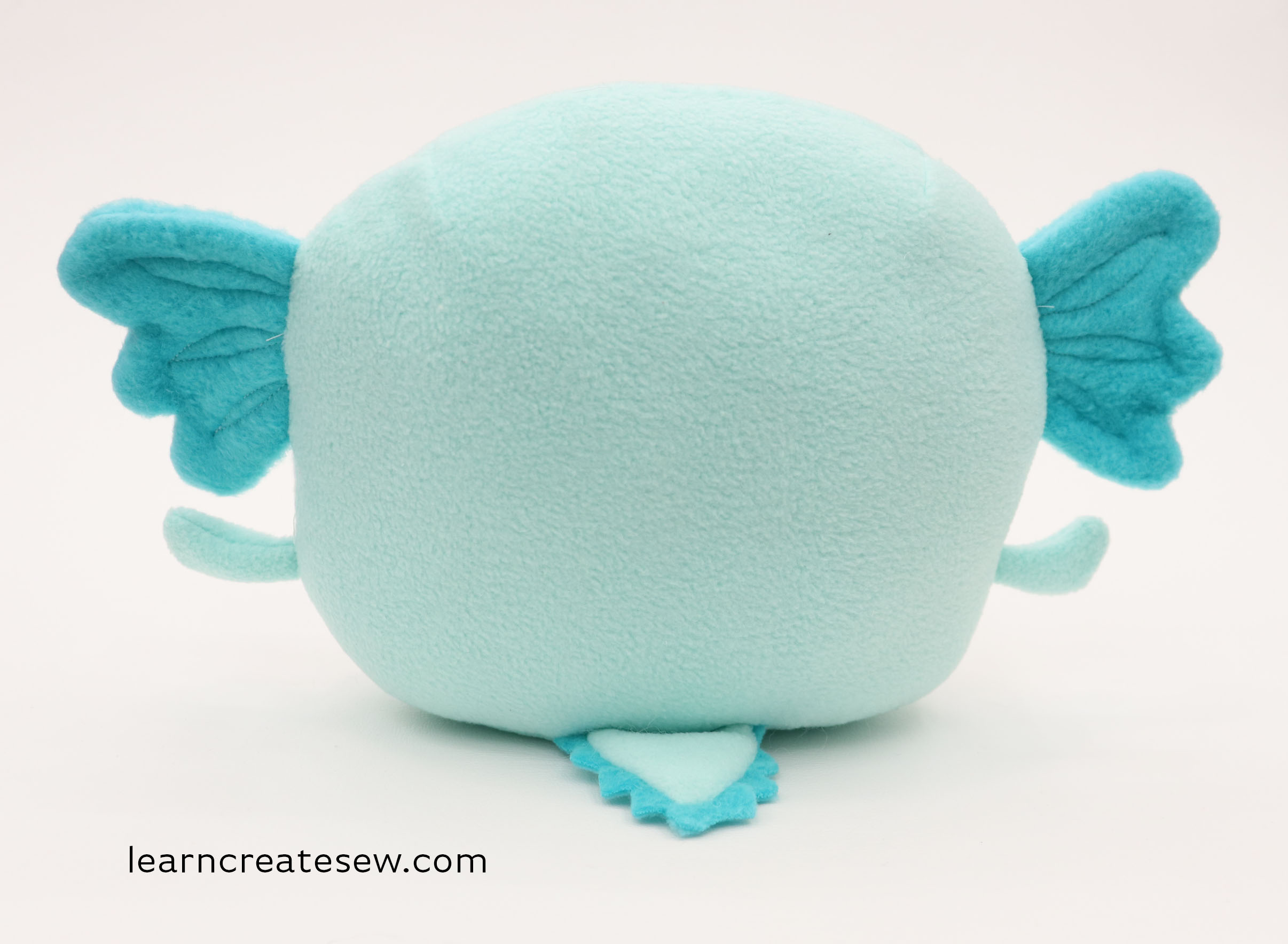
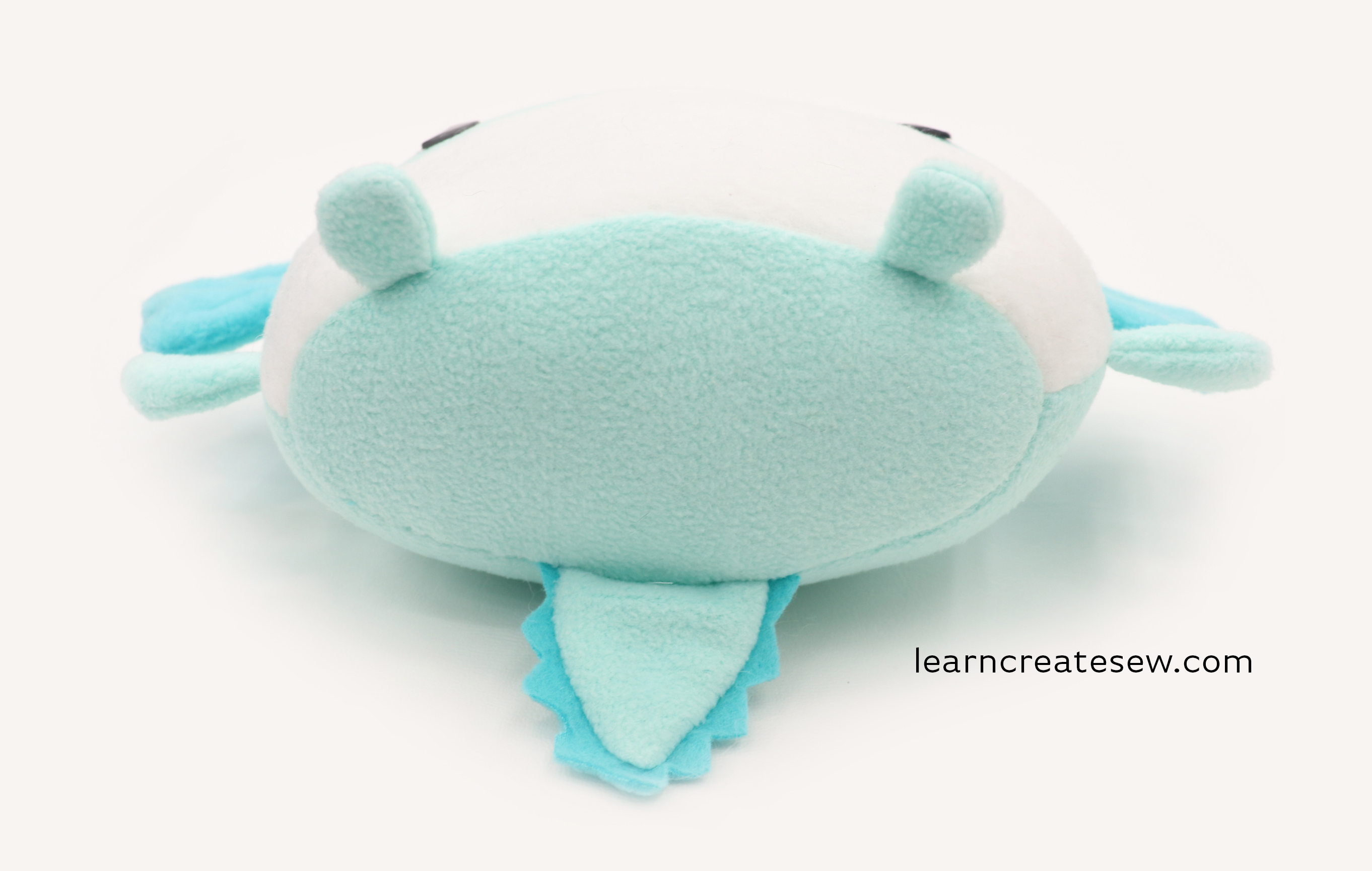
The tail is also nice. Not only is it cute, but it also helps the plush stand up.
I hope you have as much fun making this project as I did.
Happy Sewing!
Supplies:
Recommended Fabric: Fleece or Minky (Example project made from fleece). I used the Mainstays brand in hot pink, light pink, mint, turquoise, and white. 10 x 28.5 inches Main Color Fabric 4.5 x 10 inches White Fabric or 2nd Accent Color 5 x 17 inches Accent Color Fabric Coordinating Thread Two 16 mm Safety Eyes Embroidery Floss (eyebrows) Polyfil
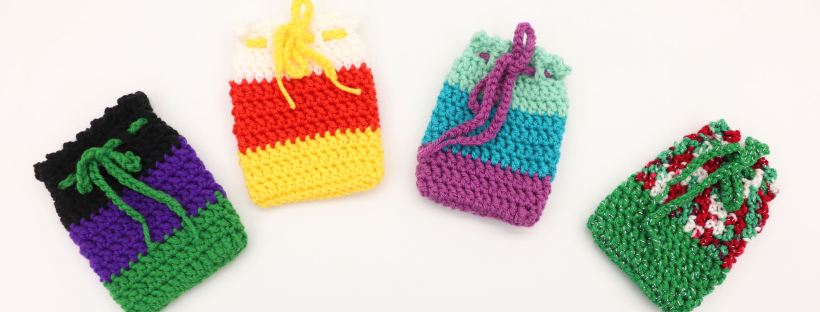
Lately, I have been looking for quick, easy, beginner crochet patterns and after a bit of searching, I decided to make a few myself. This was a lot of fun. It’s a good introduction to changing colors.
You do need to know how to do the following:
Chain
Single Crochet
Double Crochet
Slip Stitch
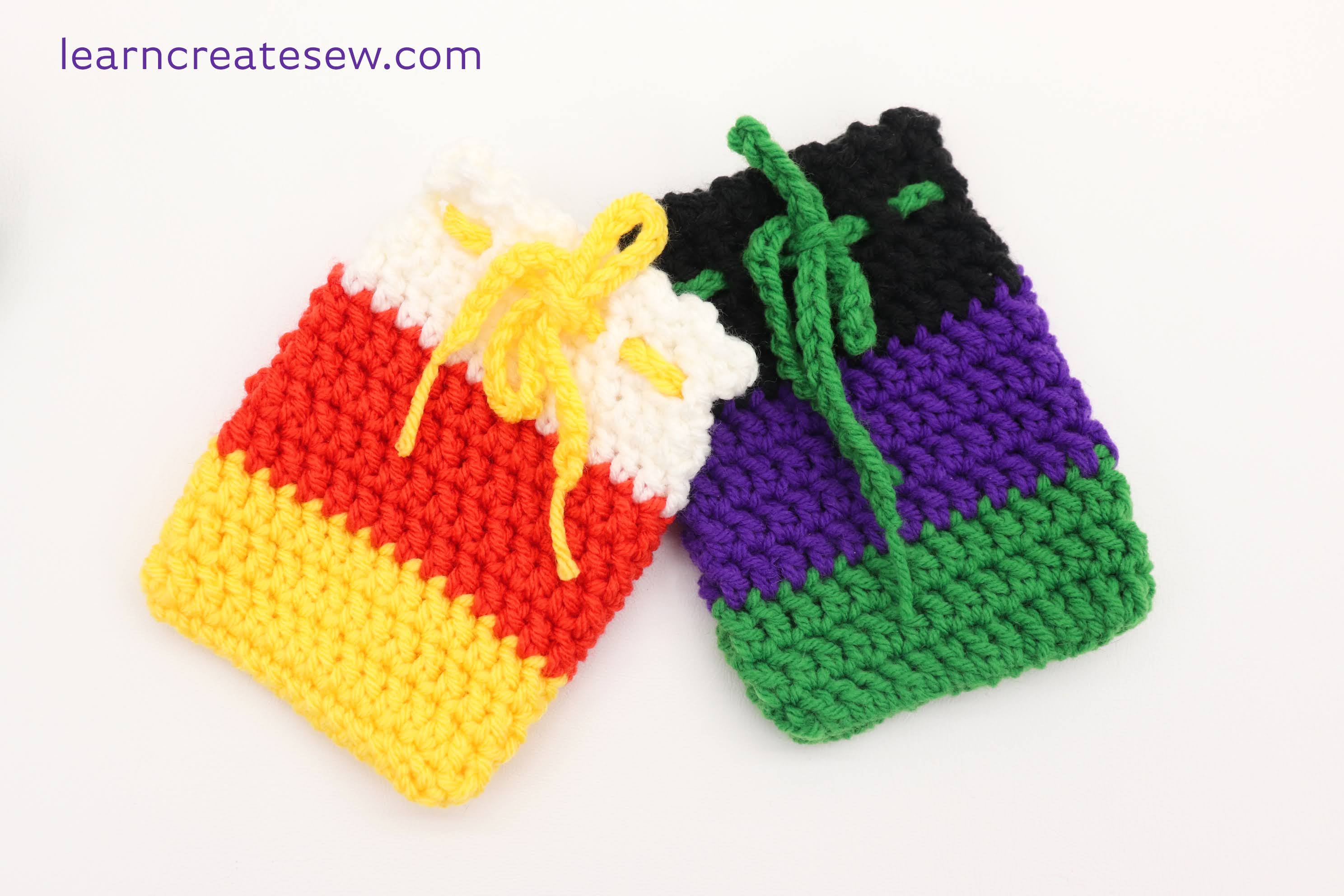
The pouch is constructed mostly of double crochet and can easily be altered by changing colors.
It would be great for gifts, holiday treats, and surprises for Halloween, Christmas, and Easter. I made these for Halloween.
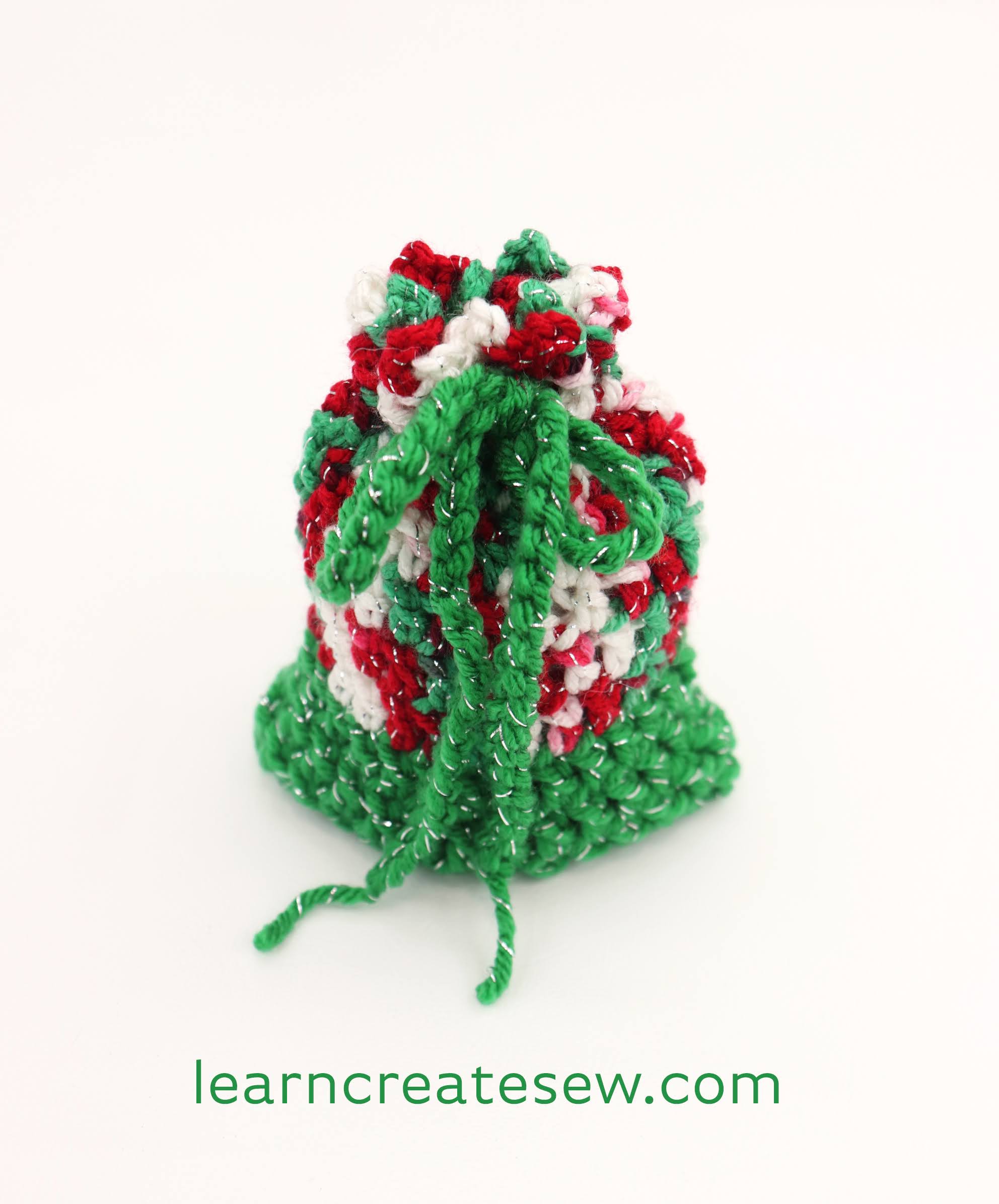
Then, I couldn’t resist making more…and of course with Christmas around the corner, I couldn’t pass up the chance to make one with red and green.
Use a 4.0 – 4.5mm crochet hook and worsted-weight yarn.
Start with the 1st Color. This will be the bottom of the bag. Leave a long tail to start.
Chain 27. Slst into the first chain to make a ring. Make sure the Vs of the chain are on the outside of the ring and the back bumps are on the inside of the ring. Take care to make sure it doesn’t get twisted.
Round 1 – 3: Chain 3 (counts as the first double crochet), 26 dc, slst into the 3rd chain from the beginning of the round (27) (3 rounds)
Change to 2nd color
Round 4 – 7: Chain 3 (counts as the first double crochet), 26 dc, slst into the 3rd chain from the beginning of the round (27) (4 rounds)
Change to 3rd color
Round 8 – 9: Chain 3 (this counts as the first double crochet), 26 dc, slst into the 3rd chain from the beginning of the round (27) (2 rounds)
Round 10: Chain 3 (counts as first dc), Ch 1, skip 1 stitch, (1 dc, chain 1, skip 1 stitch)*repeat 5 times, 3 dc, (ch 1, skip 1 stitch, dc)*repeat 6 times, slip stitch into the 3rd chain from the beginning of the round (27)
Round 11: V stitch around. ch1, (1sc, ch 2, 1 sc) all in the first stitch, [skip 1 stitch, (1sc, ch 2, 1 sc) all in the next stitch] repeat 12 times, slst into the first sc of the round. FO.
Whipstitch the bottom of the bag closed using the long starting tail. Weave in any tails.
Drawstring: Chain 80 or to the desired length.
Weave the drawstring through row 10. The 3 dc together is the center front. Insert along one side of the 3 double crochet then weave in and out exiting on the other side of the dc. Note: There are 2 dc together at the center back, pass over or under those together.
Changing Size:
You can increase or decrease the size of the bag slightly by using a different-sized hook.
You can also change the size by adding or subtracting rows and changing the size of the starting chain. To adjust the size of the initial chain, do so in increments of 4. So to increase the size you could go from 27 to 31, 35, 39, 43, etc. To decrease the size you could go from 27 to 23 or 19. This helps ensure that the ties still end up together on the front.
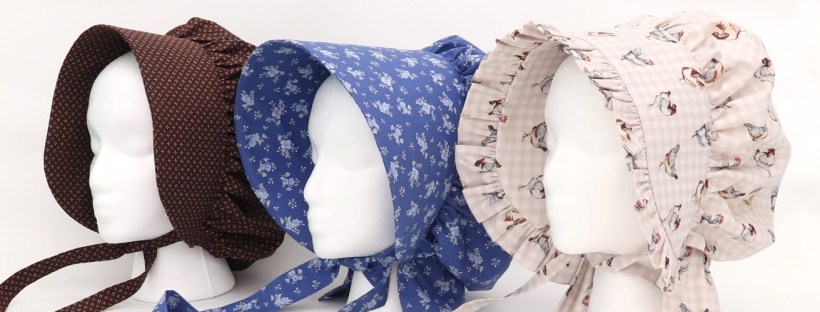
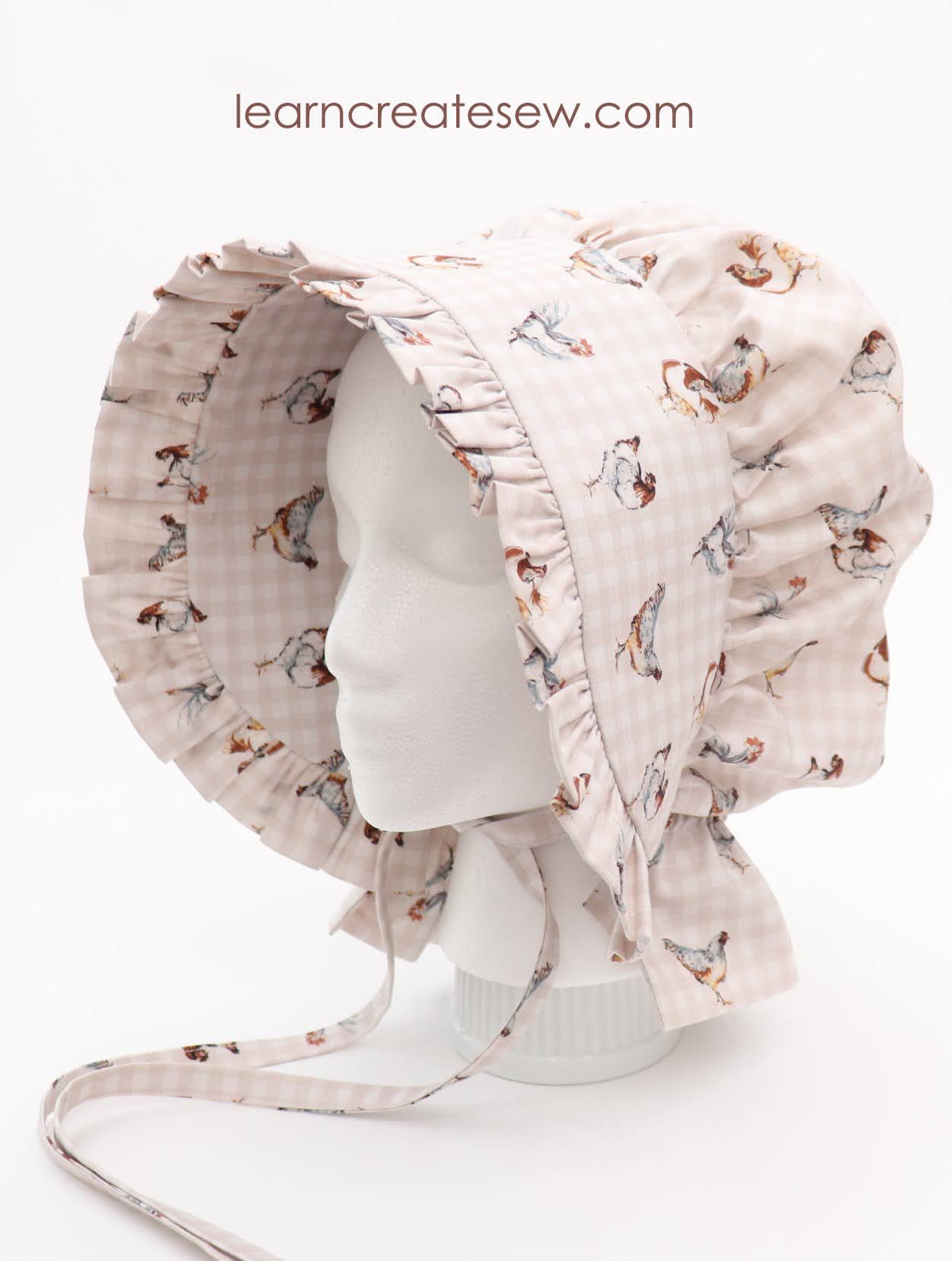
I’ve always loved westerns and western history. For years, I have wanted to make my own bonnet pattern and was excited to finally have the time to do so. I’m very happy with the results.
When I started planning the bonnet project, I wanted the project to be easy enough that beginning students could complete the project without too much difficulty. So, I started with a basic style. However, as often happens once I begin a project, I started expanding the project and exploring other style choices
The Brim
I tried various brim styles. The first brim I started with was basically a rectangle with curved ends. The result was exactly what I was looking for. Simple. straight forward. Classic. I just can’t resist ruffles, so next I tried adding a gathered trim to the edge of the brim. It’s simply one rectangle of the same fabric, folded in half and gathered. I really loved the result. So, cute!
Adding the ruffled trim does increase the difficulty. Gathering can be a difficult skill to learn and is often intimidating for new sewers. That said, I think it’s totally worth the time and effort.
After playing with the standard brim, I decided to see what would happen if I changed the shape. I extended the brim a few inches at the center front. This resulted in a more curved shape and a much more dramatic bonnet. It does limit visibility, but it is super cute 🙂 And the good news is, that swapping the standard brim for the extended brim does not increase the difficulty at all. The free pattern includes BOTH the standard and extended brim for each size. Simply choose the style you prefer.
Neck Finish
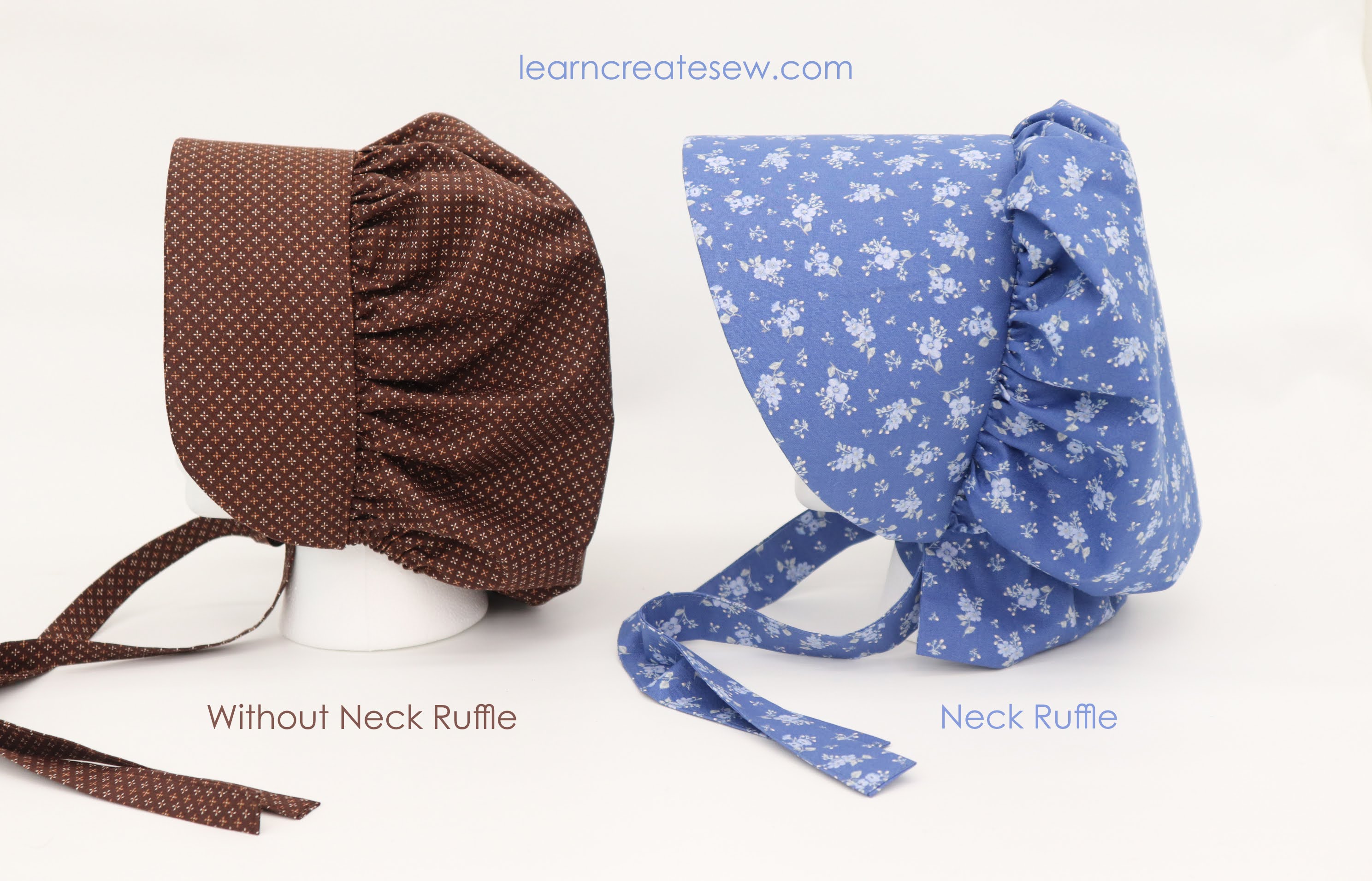
The next style choice I decided to explore was the neck finish. I began with a simple elastic casing as I wanted the project to be as easy as possible, but neck ruffles are adorable and often seen in historical examples. So, I couldn’t make a bonnet pattern without at least looking into the possibility. So, I gave it a shot. I was happy with both styles and decided to include both options with the pattern.
Neck Ties
I also explored the neckties a bit. I played with different sizes, styles, and techniques. You could also use ribbons. I tried both hand-tacking the ties in place after the bonnet was complete and sewing the ties into the brim seam. I found that for the standard brim, I prefer to sew the ties into the seam, but for the extended brim, I like to hand-tack them on later. This way the ties can be attached to the brim itself, which helps to control the larger shape. I also prefer thinner ties, but wide ties could easily be added instead. The ties on the blue extended brim bonnet are about double the width of those on the plaid ruffled bonnet.
Supplies:
The supplies listed are for the largest-sized bonnet. Smaller sizes will require less fabric.
3/4 yard Cotton Fabric
10 inches of 1/4-inch wide Elastic
2/3 yard Medium weight fusible interfacing
Coordinating Thread
Optional brim Stabilizers: Stabilizer is not required but is recommended, especially for extended or ruffled brims. Stabilizers could include Duck Canvas or heavy-weight fabric, Fusible Web, Medium-weight fusible interfacing, and/or sew-through buckram. The quantity needed will vary based on the width of the fabric. 2/3 yards or less of each should be plenty. Use the stabilizer pattern as a guide. Stabilizers are used in addition to the interfacing listed above. My favorite stabilizer combination is below.
1 layer Duck Canvas
1 layer Fusible Web (I used Heat n Bond Lite)
1 layer Medium Weight Fusible Interfacing (I used Pellon’s SF101)
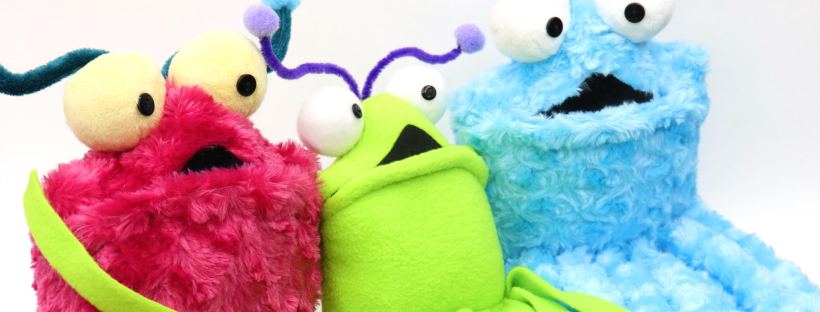
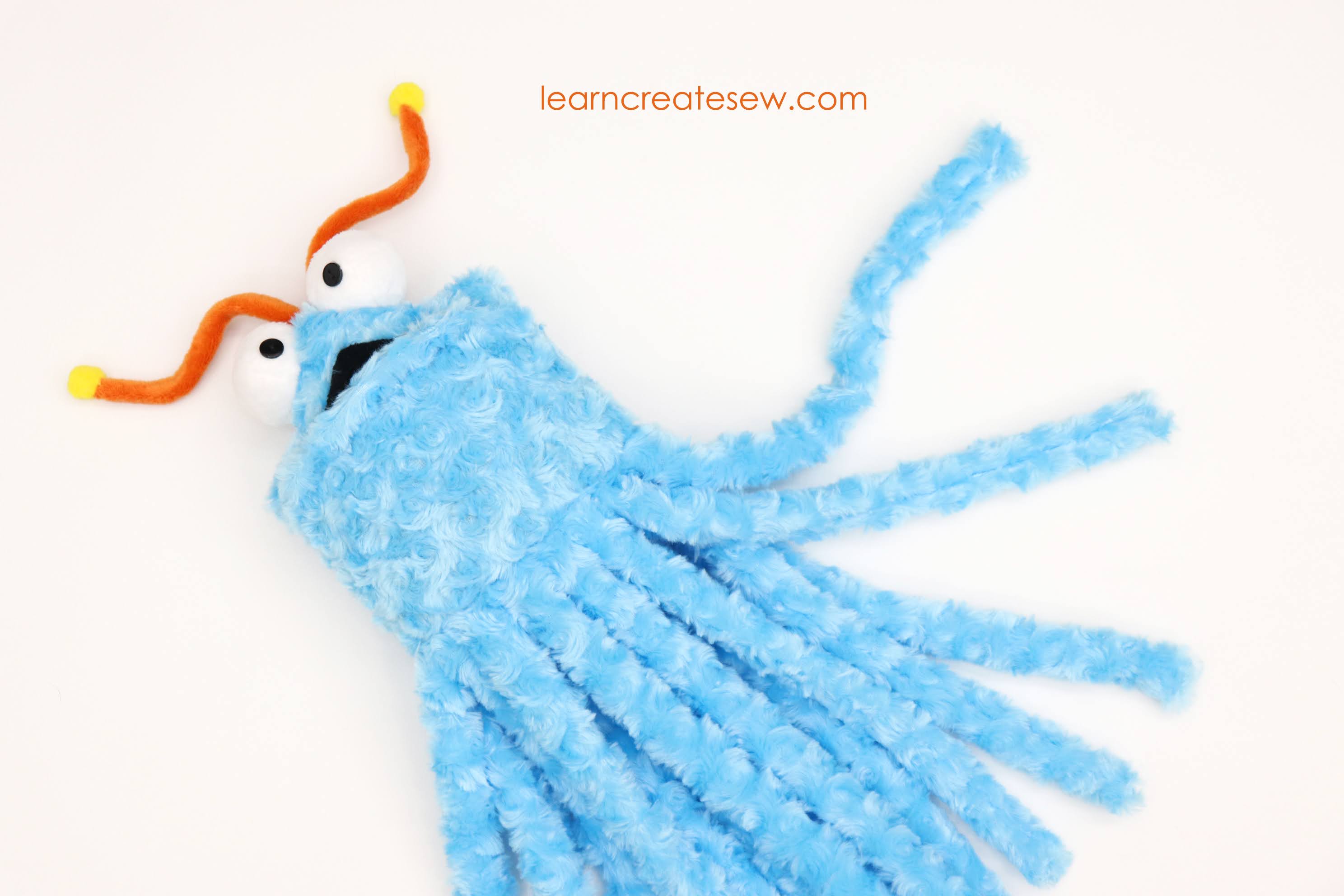
A friend asked me to make an alien plush for her daughter, and I had so much fun with it that I decided to share the project.
I started by making the larger fur aliens and then decided to add the smaller fleece option, which takes less fabric and is easier to construct.
The antenna and large eyes give these plushies a lot of personality.
Regular-Sized Plush
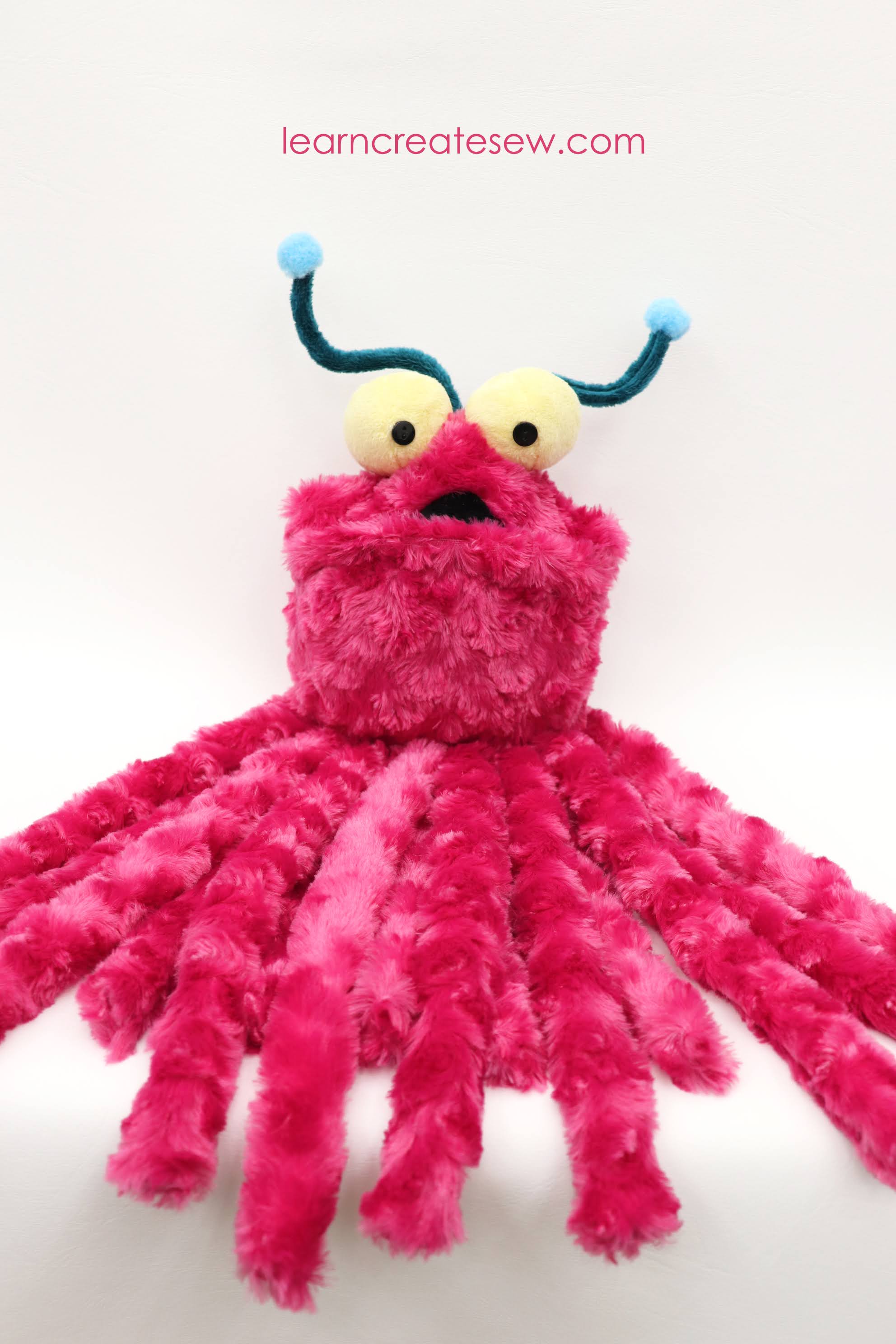
The large aliens are made with a swirl faux fur fabric (also called rose minky) for the body and regular minky for the accents. They measure approximately 20 inches tall and have finished (sewn) legs.
Small Sized Plush
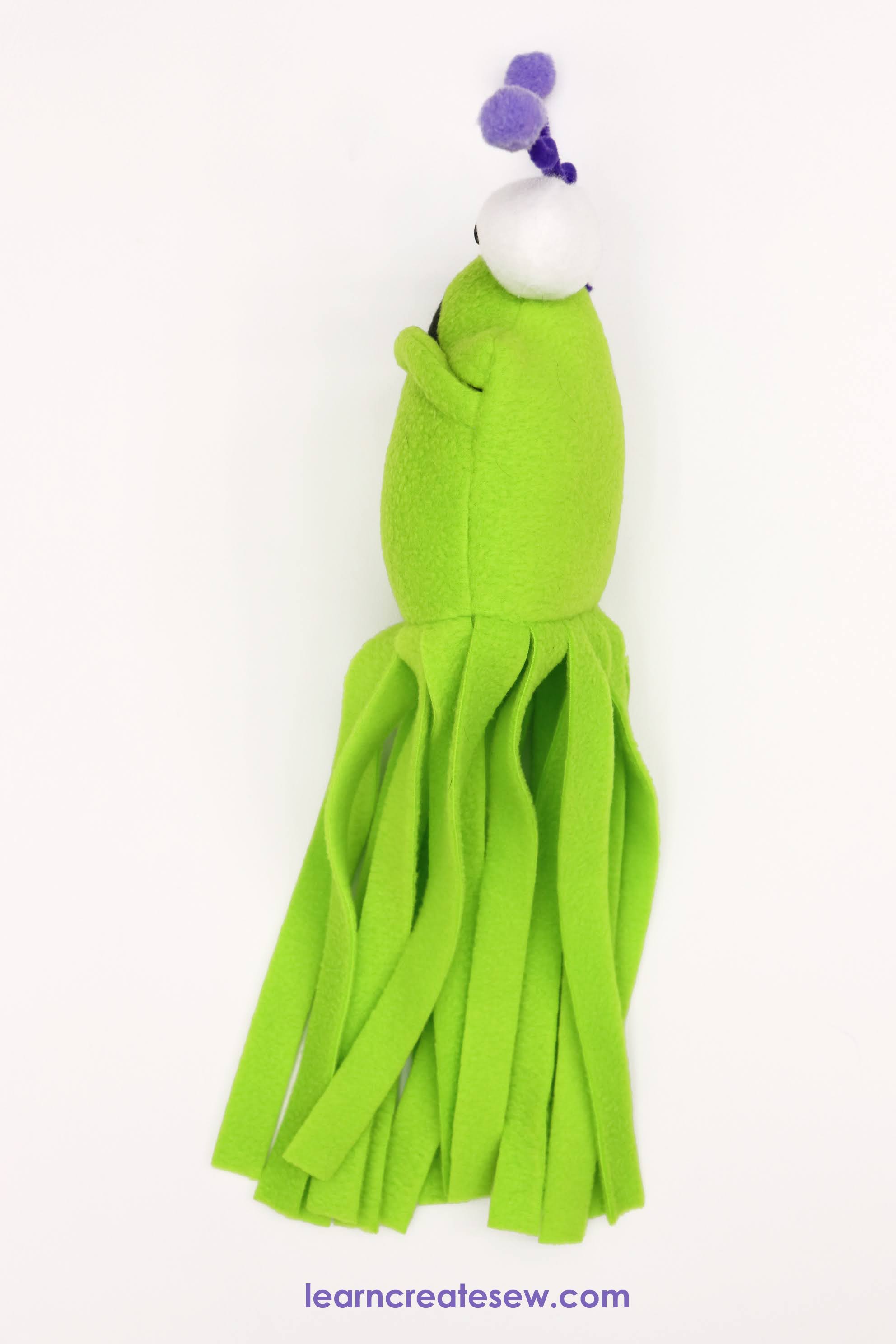
The small aliens are made with fleece for both the body and the accents and have unfinished (unsewn) legs. The small size measures approximately 15 inches tall when finished. This is 75% scale of the regular-sized plush. This plush feels considerably lighter and smaller because of the reduced size and because the unfinished legs eliminate a lot of bulk.
Finished v Unfinished Legs
You have two legs finish choices when you make the alien, finished or unfinished. The small fleece aliens have unfinished legs. This means that they are not sewn. The fabric is simply cut into strips, the edges are left raw, and they are sewn directly to the plush. This shortens the construction time by quite a bit and reduces the difficulty of the project.
The regular-sized faux fur aliens have finished legs. The finished legs are sewn individually prior to attaching them to the plush. I chose to finish the legs on the faux fur to minimize shedding and to make them stronger. The finished legs take more time and more fabric.
UNFINISHED LEGSFINISHED LEGS
Accents
The eyes and antenna of the aliens bring out their fun personalities. The eyes are sewn into balls with minky or fleece fabric and then decorated with buttons. There are two options for making the antenna, the first which is shown on the small fleece plush, is simply to bend a pipe cleaner and hot glue pom poms to the ends. The other is to cover the antenna with fabric, which is shown on the larger fur aliens. You make a fabric tube, insert wire or pipe cleaners, and then sew pom poms to the end. The single pipe cleaner option is definitely faster and easier, and I prefer that look best, but the covered option is much stronger and helps the antenna stand out.
Supplies:
Refer to the Cut Layout included with the free pattern for fabric quantities
I am so excited to be adding a new project today. It has been quite a while since my last project and I am happy to be able to share something new with you.
Recently, I was inspired by history and found some great historical projects that I wanted to make.
The first was a rag doll. Rag dolls are so easy! The body of the doll is created by tying together strips of fabric. The accessories can be sewn or not sewn depending on your preference.
Rag Doll with Sewn Accessories
The bonnet and apron are stitched to add lace trim, finish the edges, create gathers, and make casings. I used flat lace trim, but you can use pre-gathered lace as well. The yellow and white dolls above were made using cotton/poly broadcloth and 3 cotton balls for the head. The doll below was made from dyed muslin and used 4 cotton balls to create the head. The muslin doll is a bit fuller and softer.
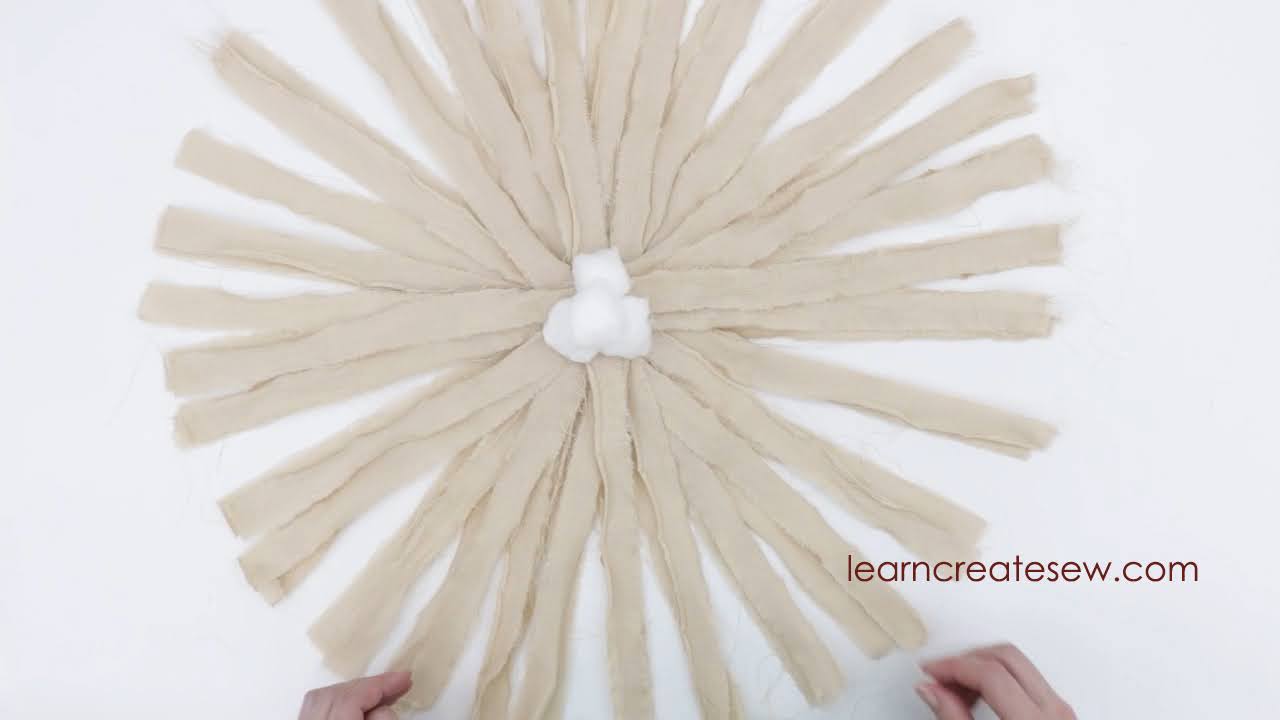
Each doll was made by ripping or cutting the fabric into strips arranged in a spiral, or wheel pattern, with the strips aligned at the center. Ties, either ribbon or fabric, are used to create the doll.
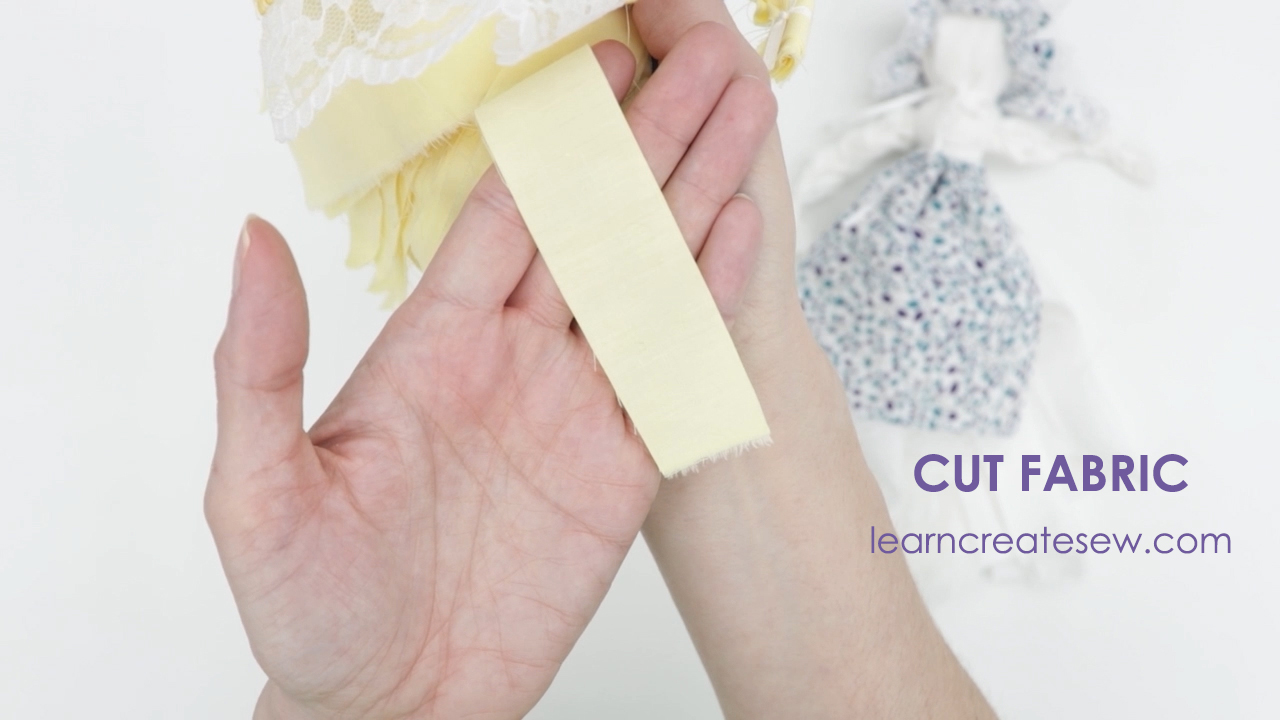
The doll will have a different texture depending on if you rip or cut the strips. The white and tan dolls were created with ripped strips, while with the yellow doll, the strips were cut using a ruler and a rotary color. The effect is a bit different. The ripped dolls are much softer and appear more rustic. They will all fray eventually since the fabric is not finished, but the ripped dolls have a lot more fraying to start.
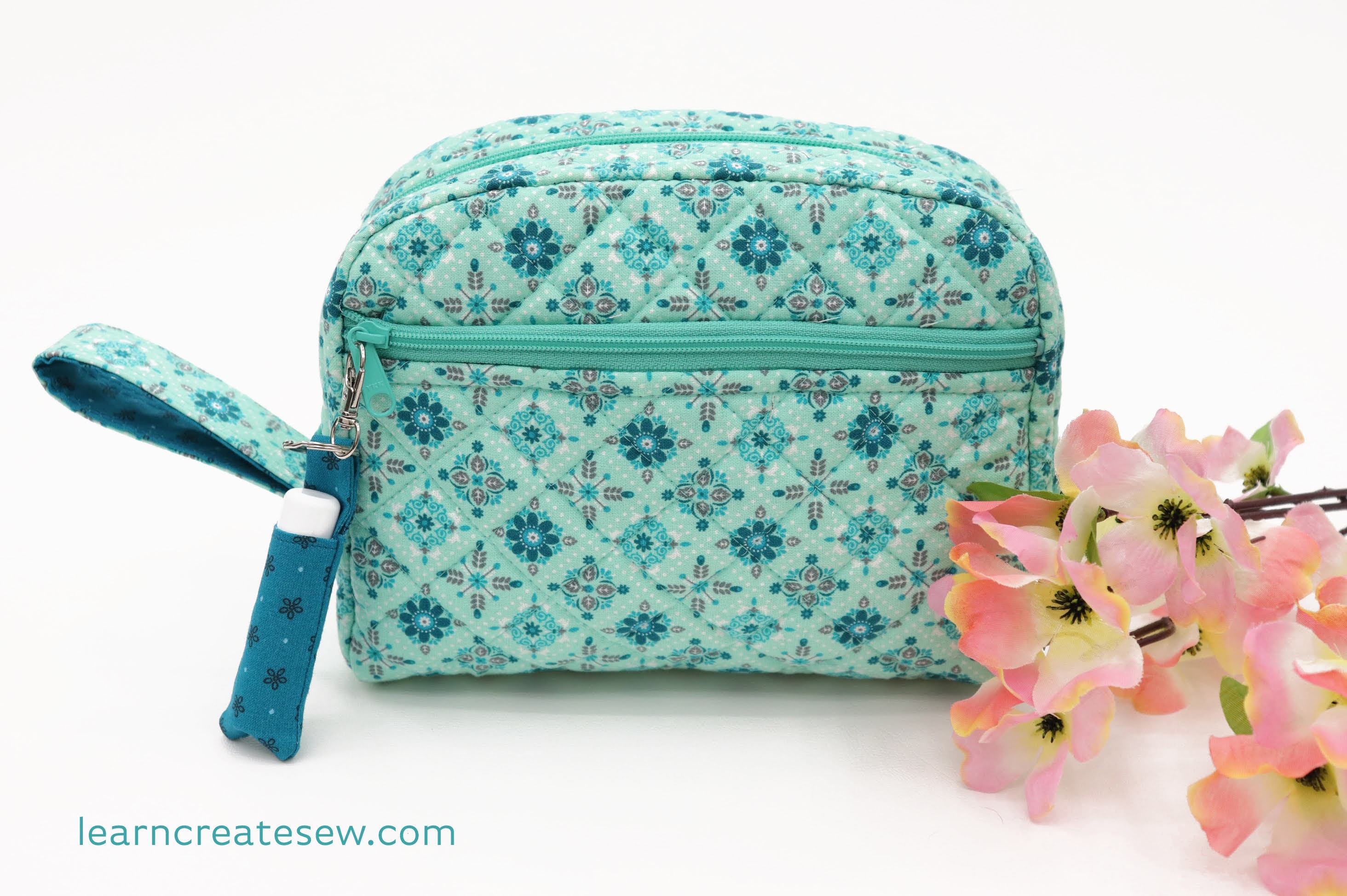
Finally! A new project! I have always loved the look of quilted bags and snatched up the chance to make this one. I used this pattern to make Christmas gifts and they were a big hit 🙂
I find this project matches well with my LIPGLOSS HOLDER, which works great as a zipper pull and looks super cute 🙂
Supplies
5/8 yard cotton fabric for the exterior of the bag (You can use a fat quarter, but it is a tight fit)
5/8 yard cotton fabric for the interior of the bag (You can use a fat quarter, but it is a tight fit)
Coordinating Thread to match exterior fabric, interior fabric, and zippers
* You can use pre-quilted fabric for this project if you prefer. You will need an 18 x 18-inch square as well as additional coordinating single-layer fabrics for the handle and tab.
Tools
Basic sewing tools and sewing machine
A fabric marking tool that vanishes or washes away ( I used Air Erase Markers)
Multiple bobbins, one for each coordinating thread color
The cosmetic bag measures approximately 7.25 x 5 x 2.5 inches.
Detailed Instructions:
Quick Overview:
This bag is made with foam interfacing, quilted between two layers of cotton. It gives the bag a nice soft appearance.
The bag has a large storage compartment, one front pocket, one handle, and one tab for opening and closing.
The bag is also completely finished, hiding all raw edges.
Even the interior pocket seams are hidden in this project!
To hide the seams I used single-fold bias tape, which lays flat over the seam allowance. As a result, you do see the stitches on the outside of the project, but they blend in nicely with the quilting stitches.
I find it easier to attach the binding prior to sewing the side gusset in place.
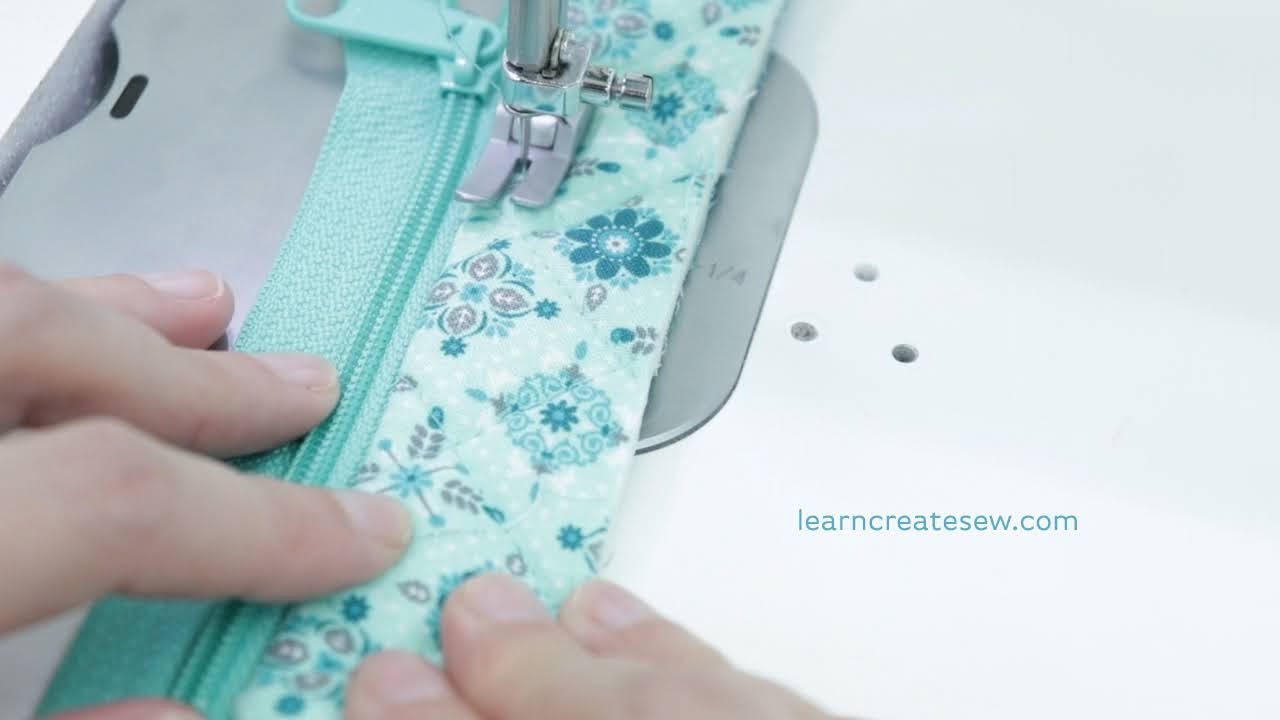
The zipper tape itself is used to hide the seam allowances along the edge of the zipper.
Topstitching helps the zipper to lay flat and encases the raw edges under the zipper tape.
I hope you enjoy making this yourself! Happy Sewing 🙂
I absolutely love corset making! I have made several over the years, and while they can be a challenge I always consider them a fun endeavor and a great addition to many costumes.
I recently picked up the book Corset Making by Julie Collins Brealey, and I really enjoyed it. I used the techniques described in her book to draft my own underbust corset pattern. It turned out great! I highly recommend her book if you would like to draft a corset pattern specific to your body measurements.
After completing my corset several of my students expressed interest in making a corset of their own. So, I decided it would be fun to share the techniques I used with everyone! This is just a simple costume corset and is not intended for tight lacing. I also used budget-friendly easy-to-find materials. For beginners, I think it is important to see if you enjoy the process of corset-making before investing in some of the more expensive materials and tools. I find corset making very rewarding, but many find the process frustrating and would prefer to purchase a ready-made corset instead.
But for those willing to face the challenge, who love corsets as much as I do, this tutorial is for you!
What are the most important skills in corset making, you ask? Organization and precision!
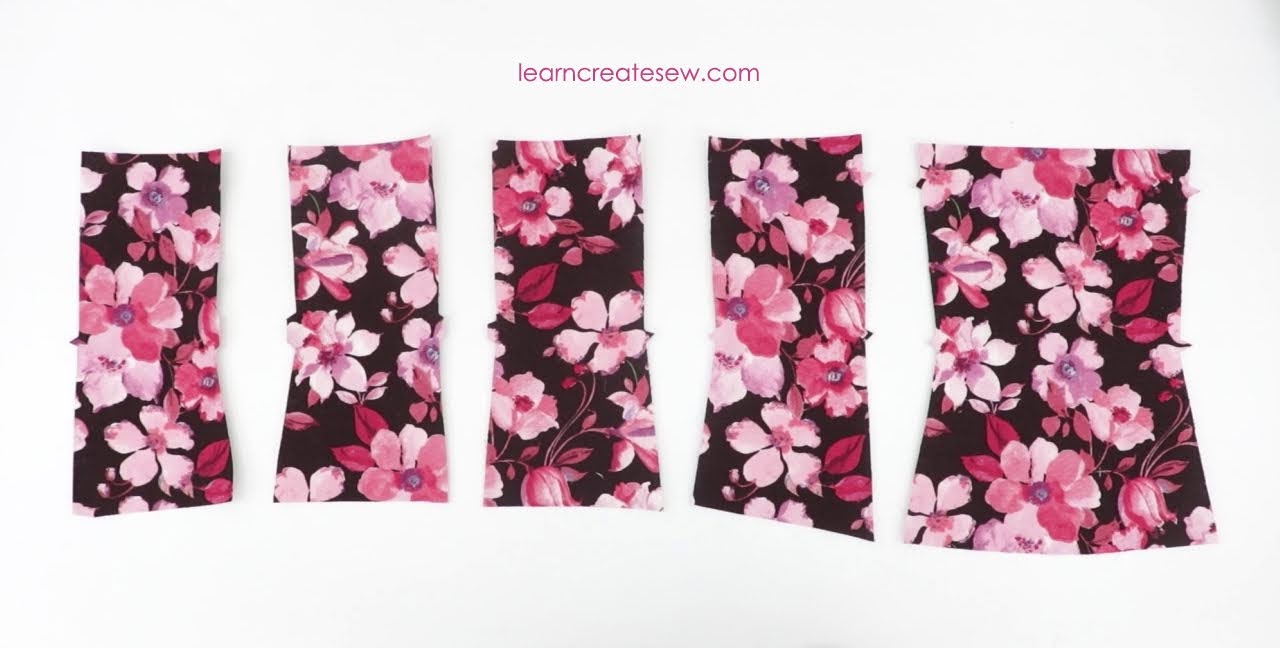
Unfortunately, in corsets, errors are often amplified. There are SO many seams, that a small discrepancy in cutting or sewing can leave the size of your corset off by an inch or two. As a result, I make precision a priority and cut the pieces out in a single layer. Corsets have tons of pieces. Those pieces often look very similar. It is super easy to get them mixed up. As a result, I like to label all of my pieces with significant markings, piece names, and top edges. This helps me ensure that I don’t get pieces mixed up while I am sewing.
For similar reasons, I like to lay out my pieces in the correct order prior to sewing so they stay in the proper position as I put them together.
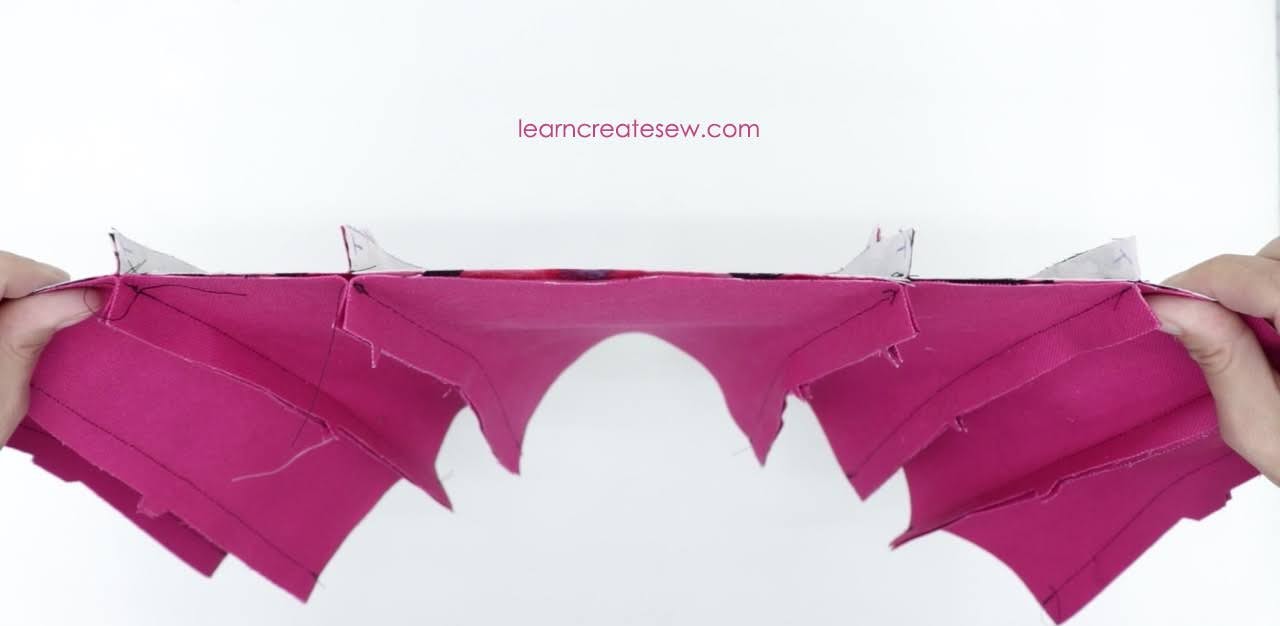
This corset is constructed by assembling a fashion layer and a structure layer and sandwiching them together. Boning casings are made by sewing the two together. No separate casings are needed!
The trick is to ensure that those two layers are the same size so the seams align!
I tried two different pressing methods for my corset. Pressing the seams open and pressing to the side. Watch the detailed instructional video to see what I liked best!
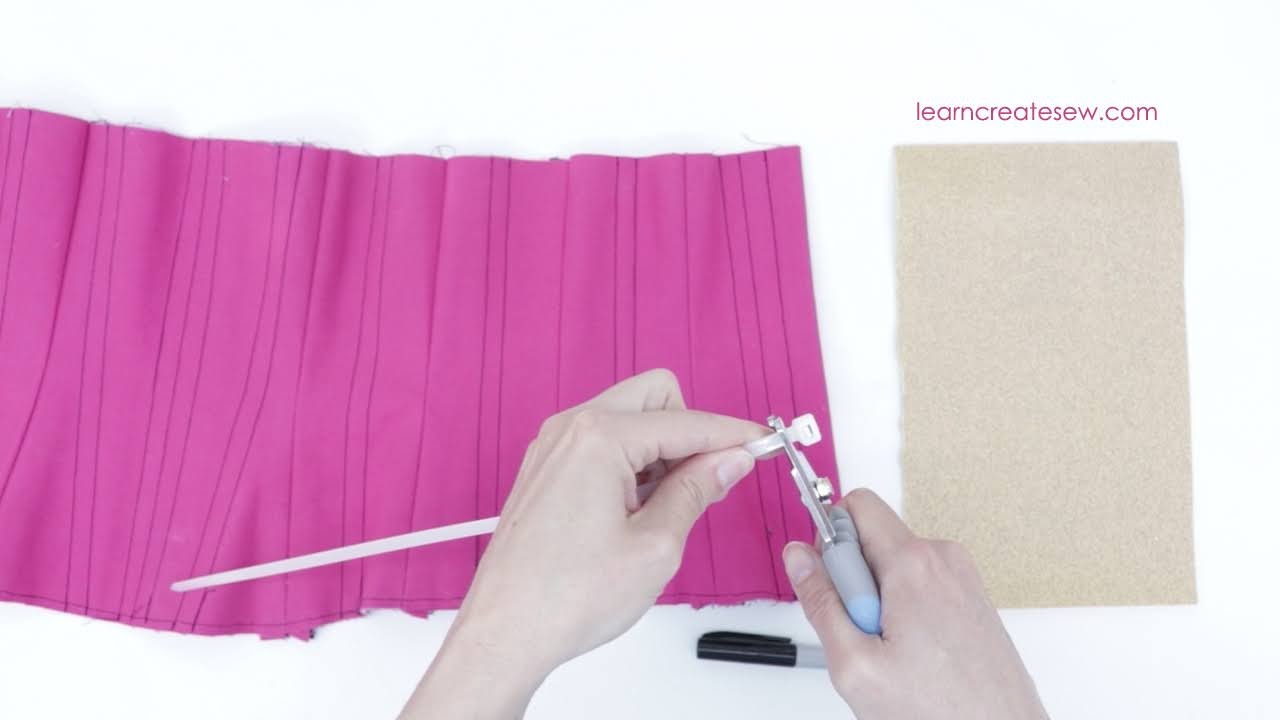
I used zip ties for the bones in my corset! I have always wanted to try them out, and while I found that a lot of them weren’t perfectly straight, they worked great! It was simple to grab a package of zip ties and some pet nail trimmers at Walmart. No waiting for shipping or delays. While they may not be the best option, they worked surprisingly well, and I wouldn’t hesitate to use them again for simple costume corsets.
Rather than eyelets, I used grommets with washers in my corset. These are a bit stronger and last longer. I used a grommet press, but grommet setters that use a hammer are also available.
To finish off the corset I made coordinating bias binding. You can see my skill-building tutorial for how to make your own! I just love it when the binding actually matches your project!
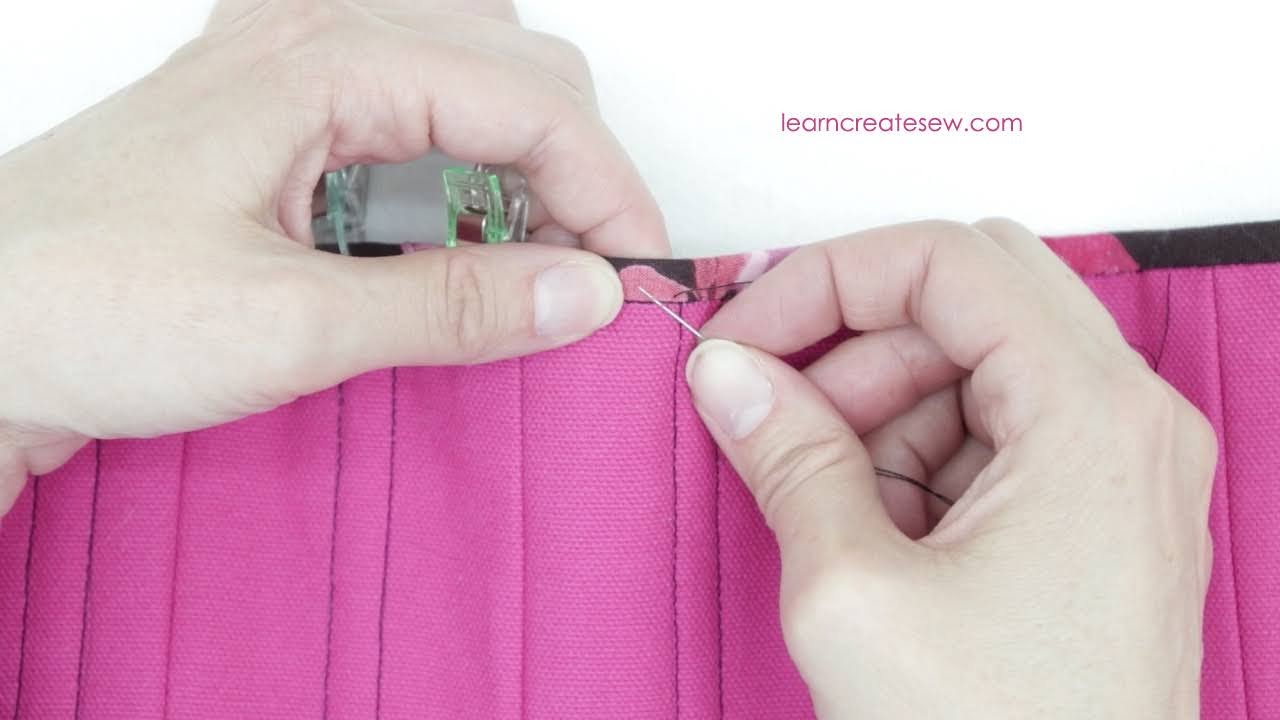
I like to finish the binding by hand to give it a nice finish.
Supplies: (Actual quantities may vary depending on size and style)
Patterns: PATTERNS INCLUDE NEGATIVE EASE! There is an intentional 2-inch gap in the back. Corset will be smaller than the measurements given. (Measurements indicated are the body measurements, not corset measurements, with the exception of height.)
Measurements are in INCHES
Size
Underbust
Waist
High Hip
Waist to HH
Height at Center Front
Original
30
29
34.5
3.5
9.5
C
26.4
23.9
29.7
4
9
D
28
25.5
31.3
4
9
MORE SIZES COMING SOON!
Size Original: (UB 30, W29, HH 34.5, W to HH 3.5, CF Height 9.5)
I was recently asked to help with a service project at our school. Parent volunteers are making curtains for all the classroom windows! They are going to be so nice!
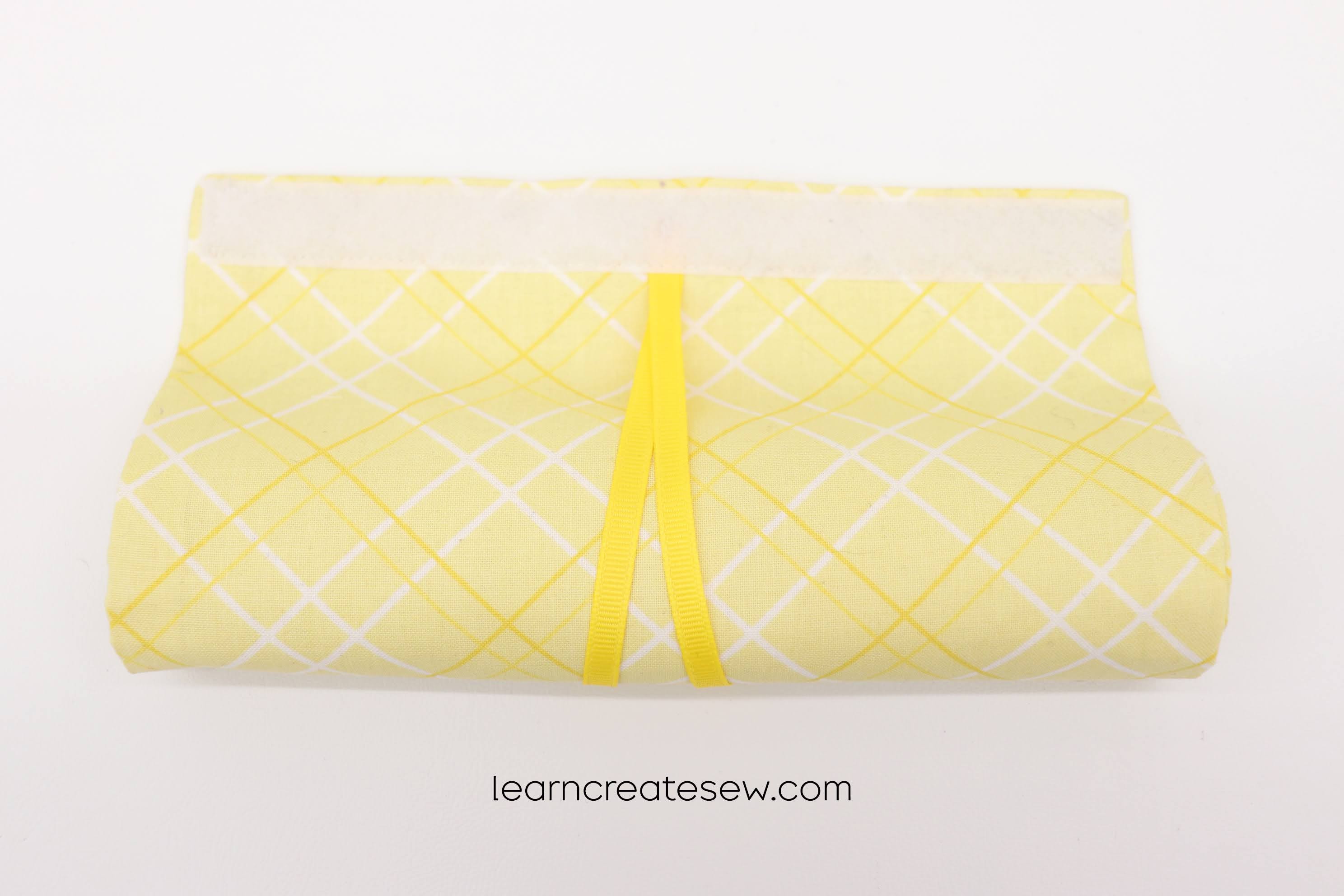
Our school will be attaching the curtains to the door using velcro. If your school isn’t doing that you can use magnets, or ribbon loops with 3M hooks instead.
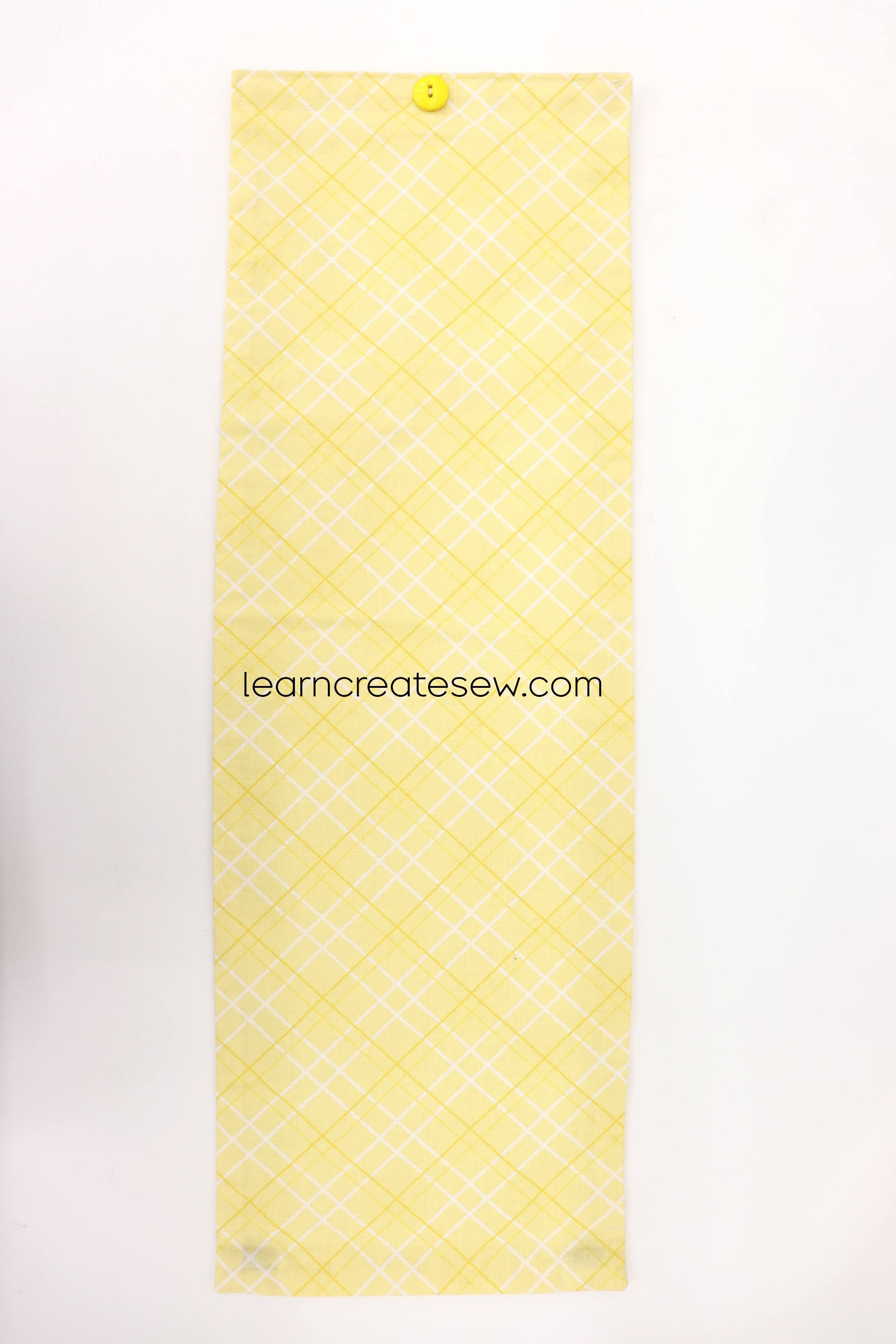
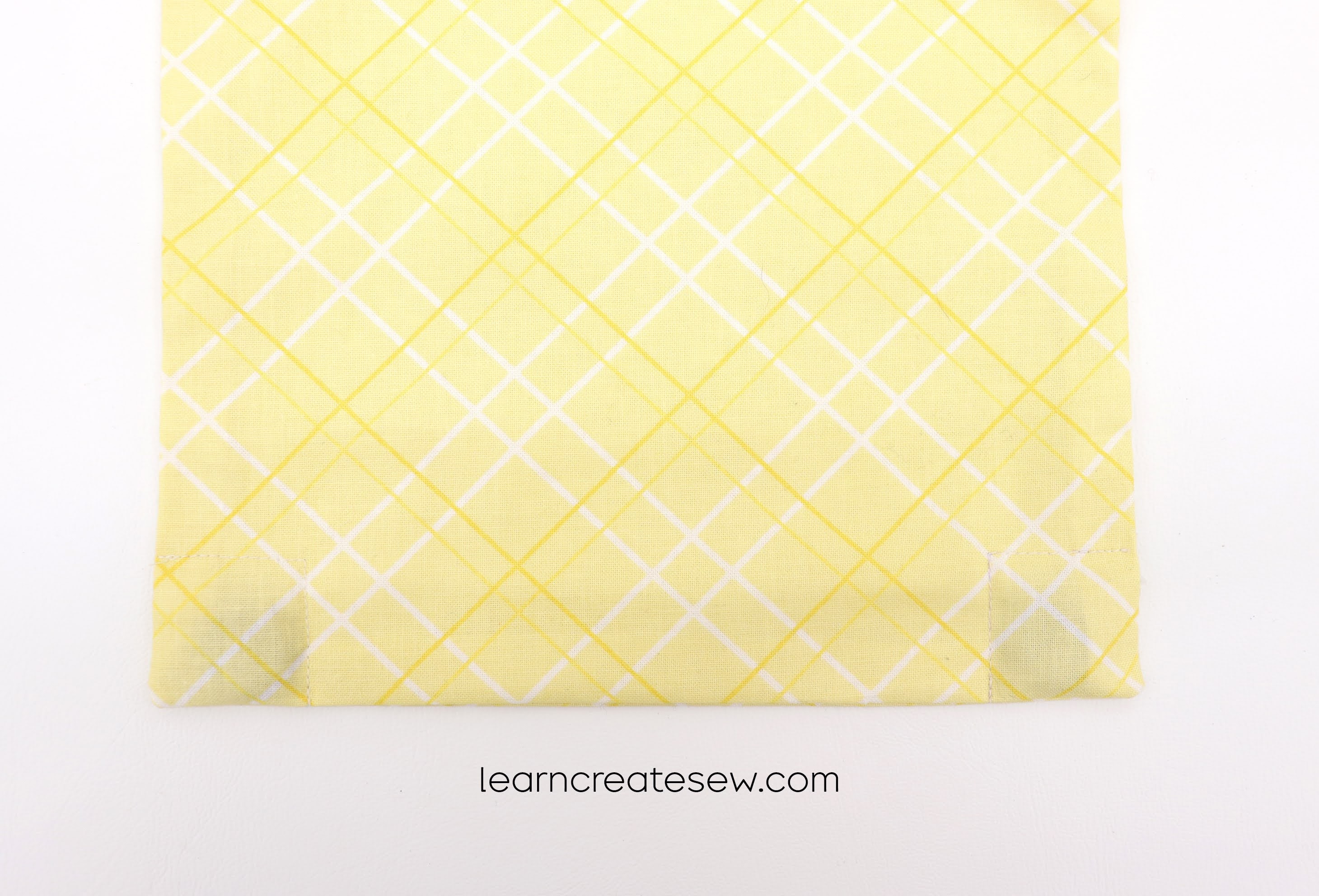
There are two magnets at the base of the curtain which will help it stay in place when in use. If you don’t want the magnets to be visible on the outside of the curtain, select a darker fabric print.
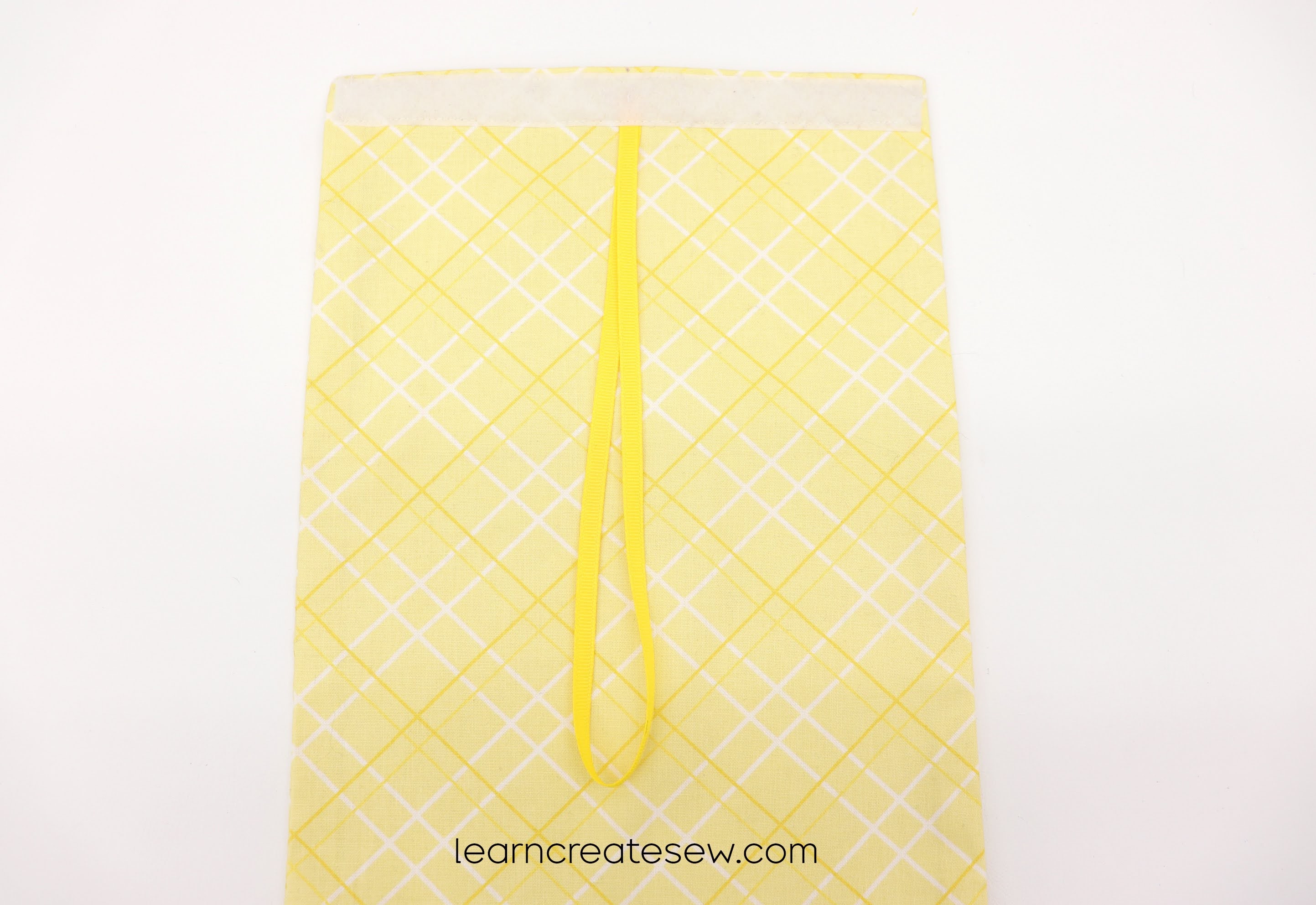
A ribbon and button will hold up the curtain when it is not being used.
This is a quick and easy project and can usually be completed in 15 – 30 minutes.
Supplies:
3/4 yard of cotton fabric (this is enough fabric for two curtains)
1/2 yard ribbon (1/4 inch wide) – (You will need more if you plan to attach the curtain using loops)
One Button (3/4 – 1 inch wide)
Sew-on Velcro (Loop side only – Approximately 1/4 yard)
Two Magnets (18mm) – (I needed 6 magnets to attach the curtain to the frame without the velcro)
Coordinating thread
Tools
Sewing Machine
Ruler
Fabric Marking Tool
Zipper foot (optional, but may be necessary on some machines)
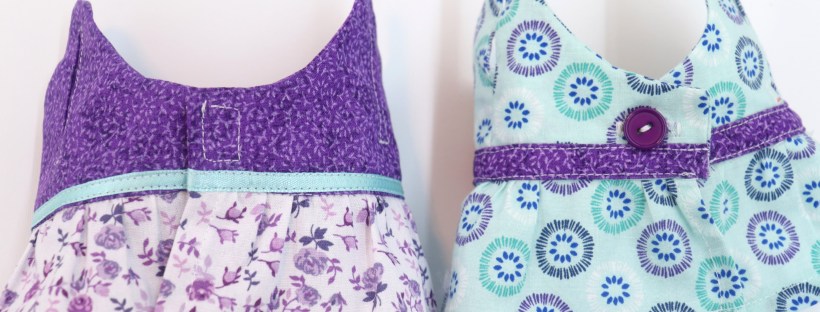
I have long been meaning to post a tutorial on how to make a dress for the Sloth plush, but it always seemed to slip my mind. A special thanks to Carol for reminding me about it! The dress is a cute little addition to the sloth plush and a lot of fun to make.
I don’t have a video for this one, but I do have several photos. I hope you find them helpful.
Here are some quick instructions on how to make the dress.
First, cut out the pieces. The skirt rectangle is approximately 3 x 18 inches, but you can adjust that as desired.
Hem the bottom and two sides of the skirt with a double-fold narrow hem. Approximately, 1/4 inch wide.
Gather the top edge.
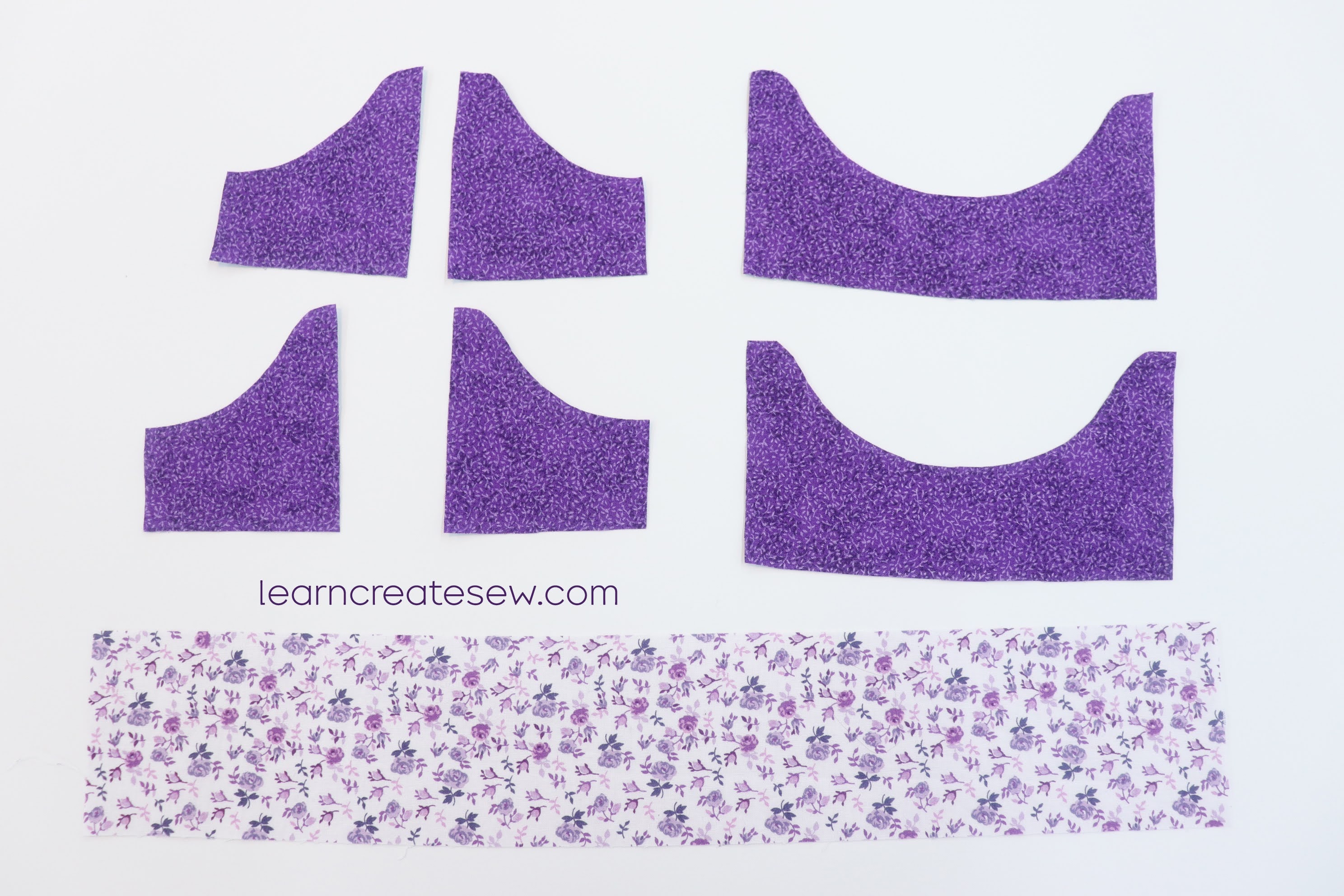
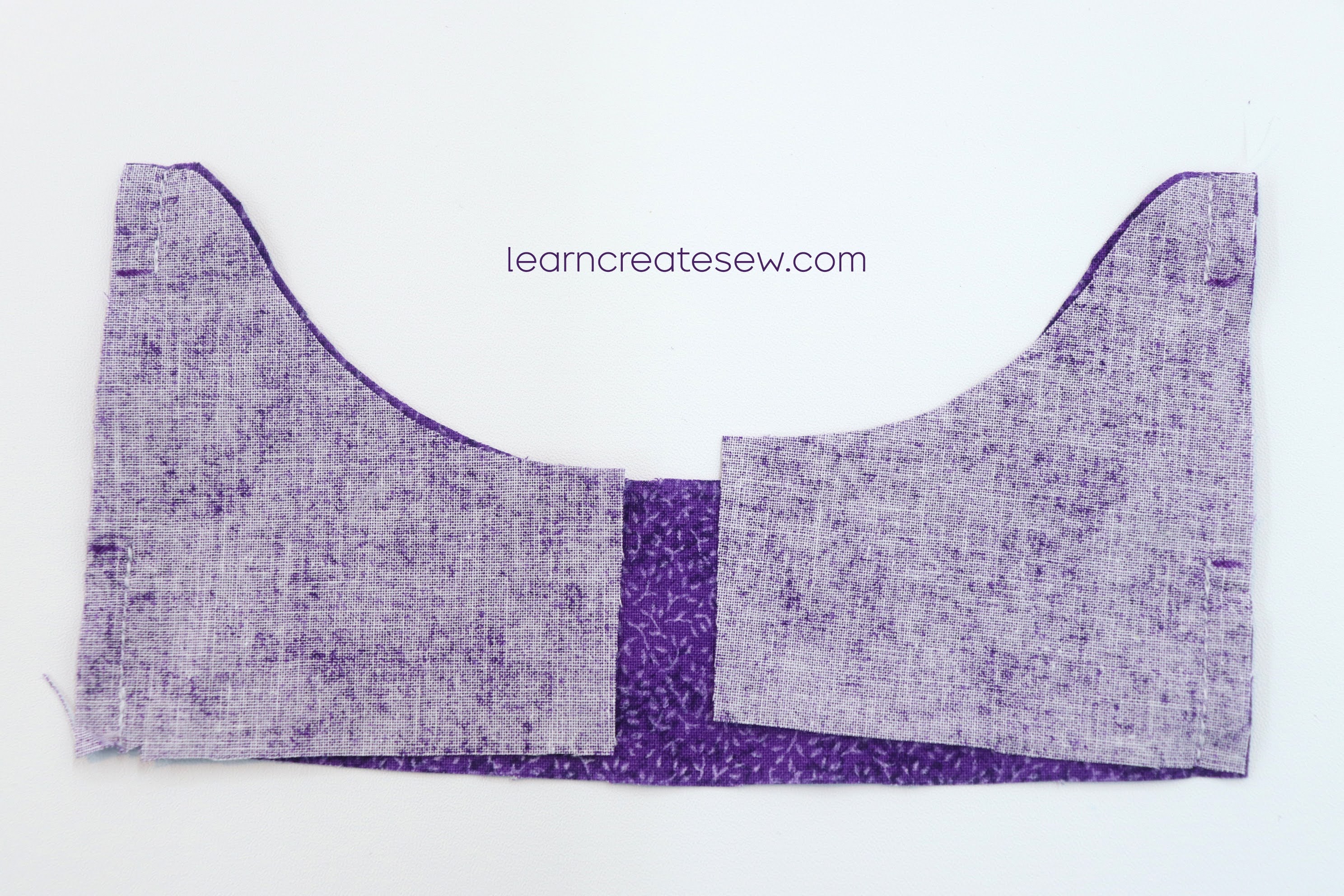
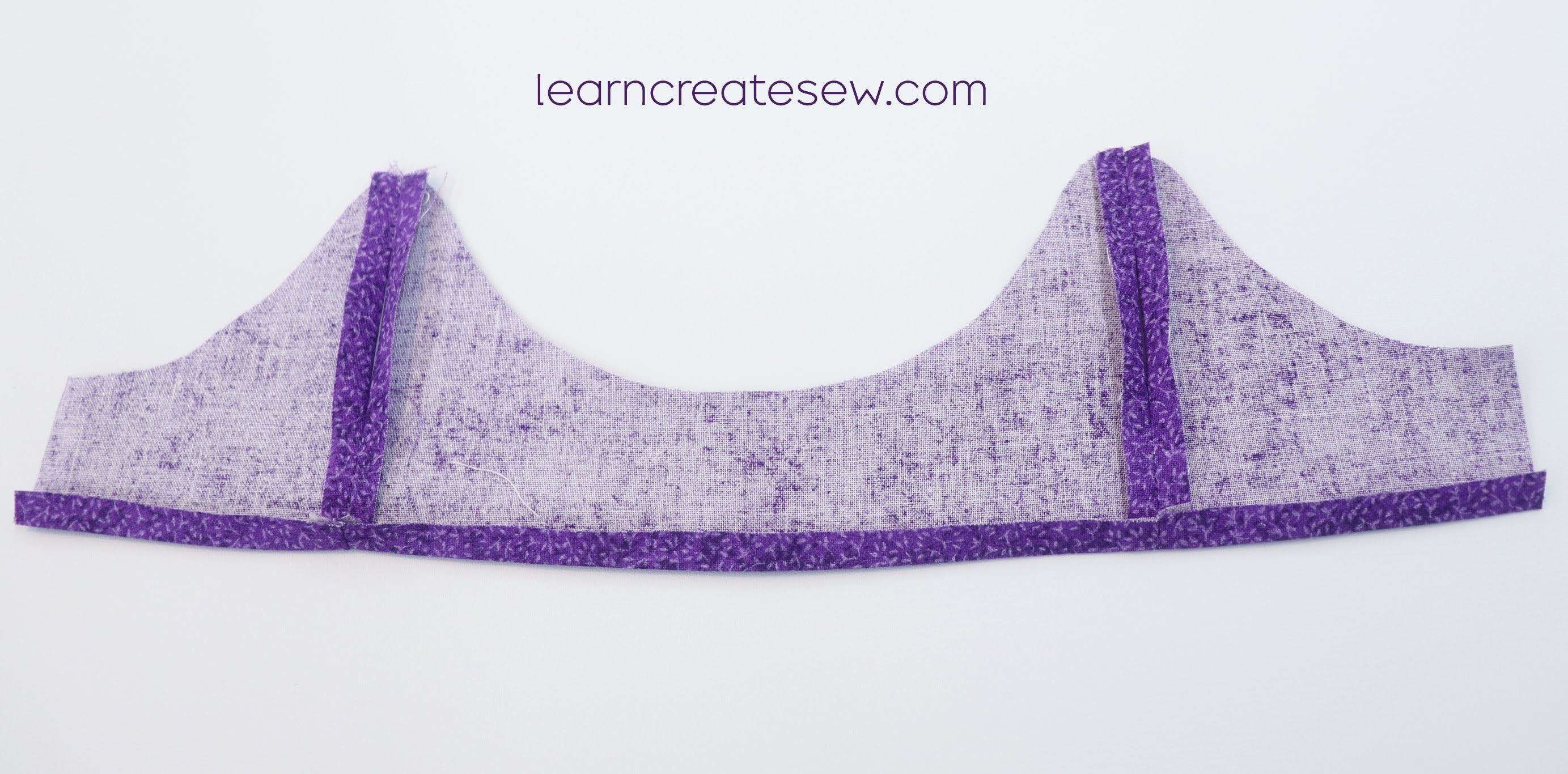
Pin two of the bodice front pieces to a bodice back piece, right sides together. Align the dashes marked on the pattern.
Stitch the side seams with a 1/4 inch seam allowance. Only sew above and below the dashes, leaving a gap in the middle. This is for the sloth’s arms to pass through.
Repeat this process again for the other front and back pieces. You should end up with two identical dress bodices. Press the side seams open on both bodices.
Fold up the bottom edge of one of the bodices 3/8 inch. Press. Keep the bottom edge of the other flat.
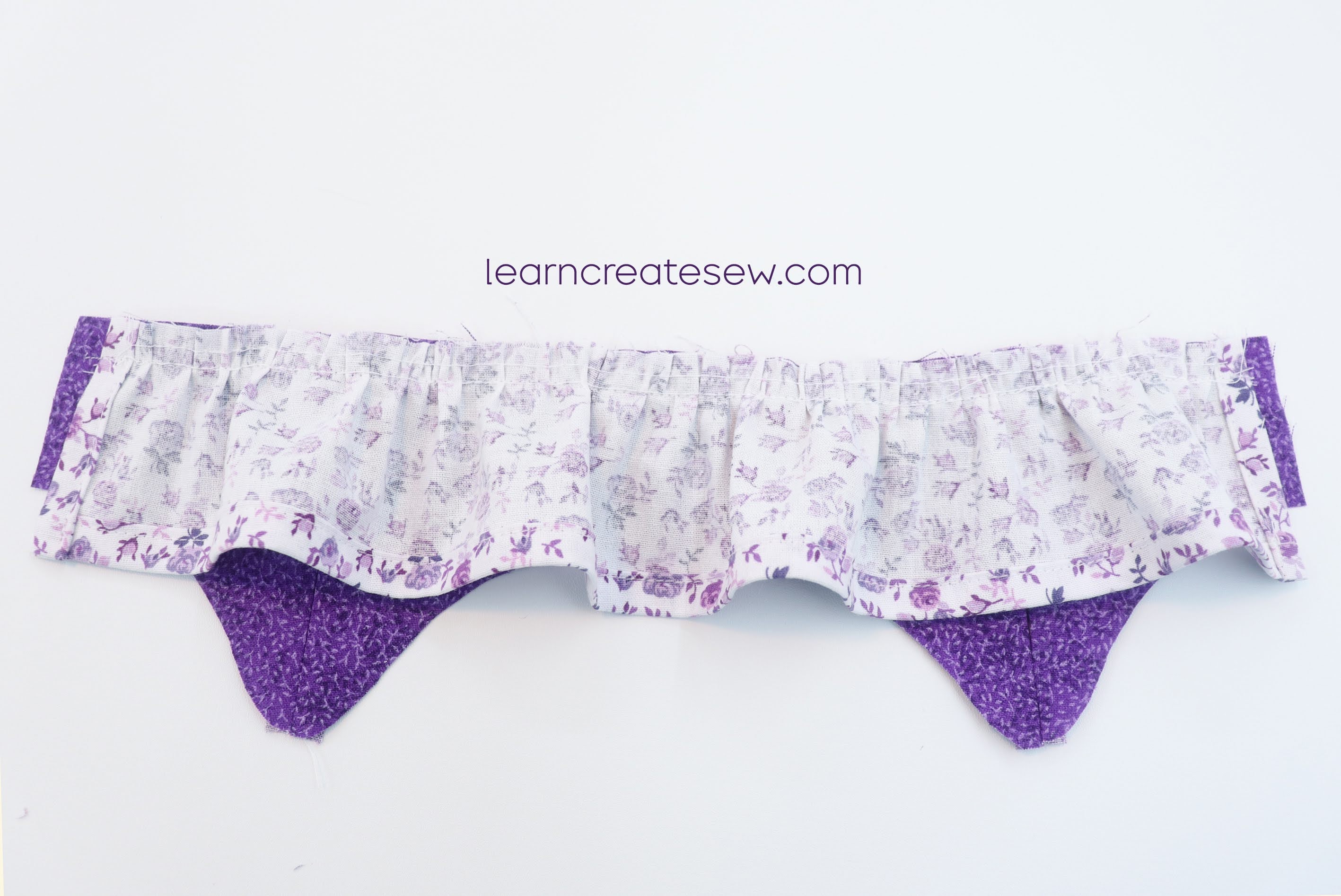
Lay the bodice with the bottom edge flat (the one you did not press) right side up. Place the skirt right side down on top of it. Align the gathered edge of the skirt with the raw edge of the bodice. Let the bodice extend an extra 1/4 inch on each side beyond the skirt. Stitch the skirt in place along the gathered edge with a 1/2 inch seam allowance.
Flip the skirt down and press the seam allowance toward the bodice.
Place the dress right side up. (You can disregard the topstitching shown on the bodice in the photo. It’s not necessary in this step. We will get to that later.)
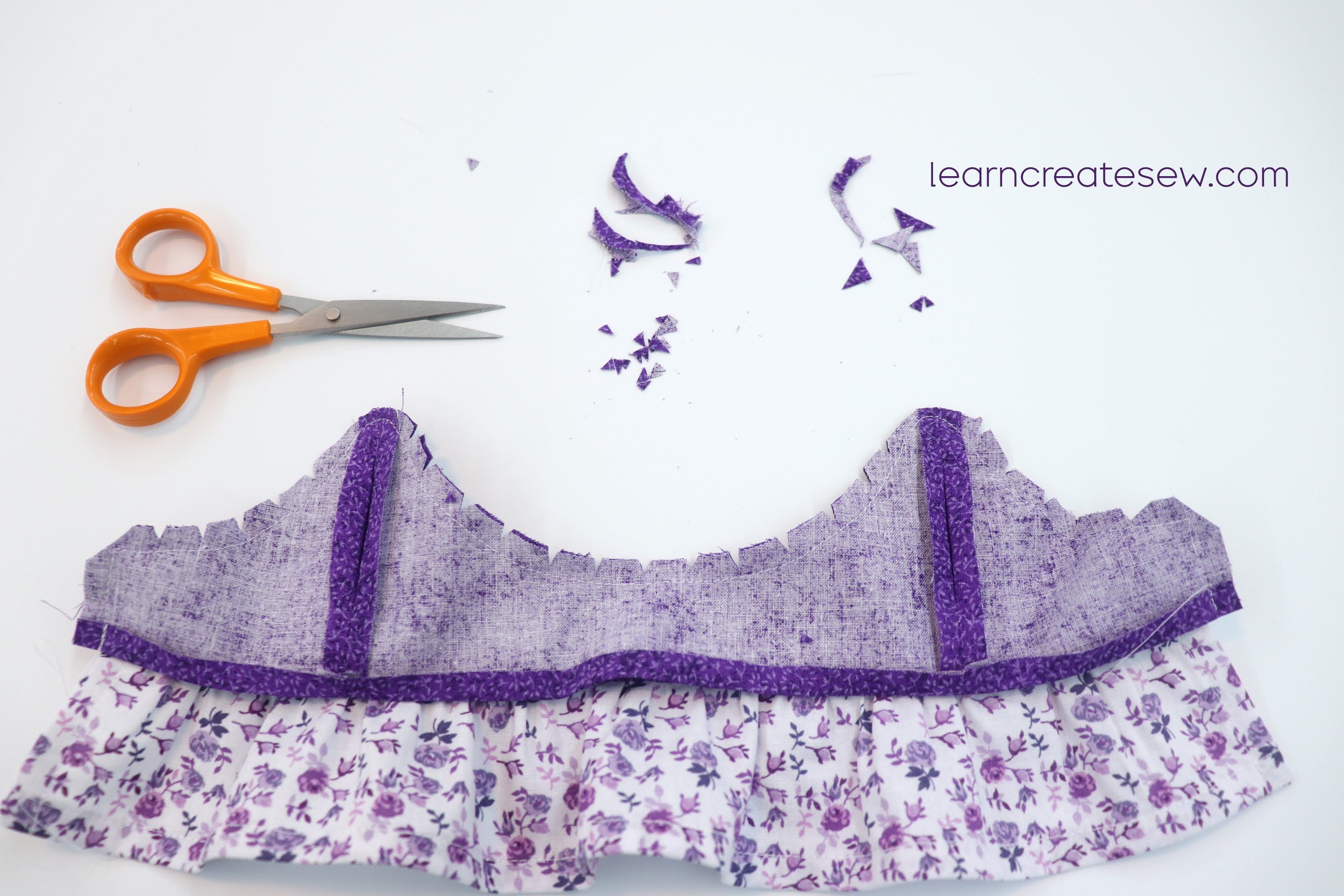
Lay the other bodice, the one with the folded bottom edge, right side down on top of the dress. Align seams and edges of the bodice pieces. Make sure the seams are open and flat. Sew all of the way around the edge of the bodice with a 1/4 inch seam allowance, everywhere except the bottom edge where the skirt is attached, that will stay open. (None of your stitches should be on the skirt section. Only the bodice fabric is being stitched.)
Clip the curves and corners.
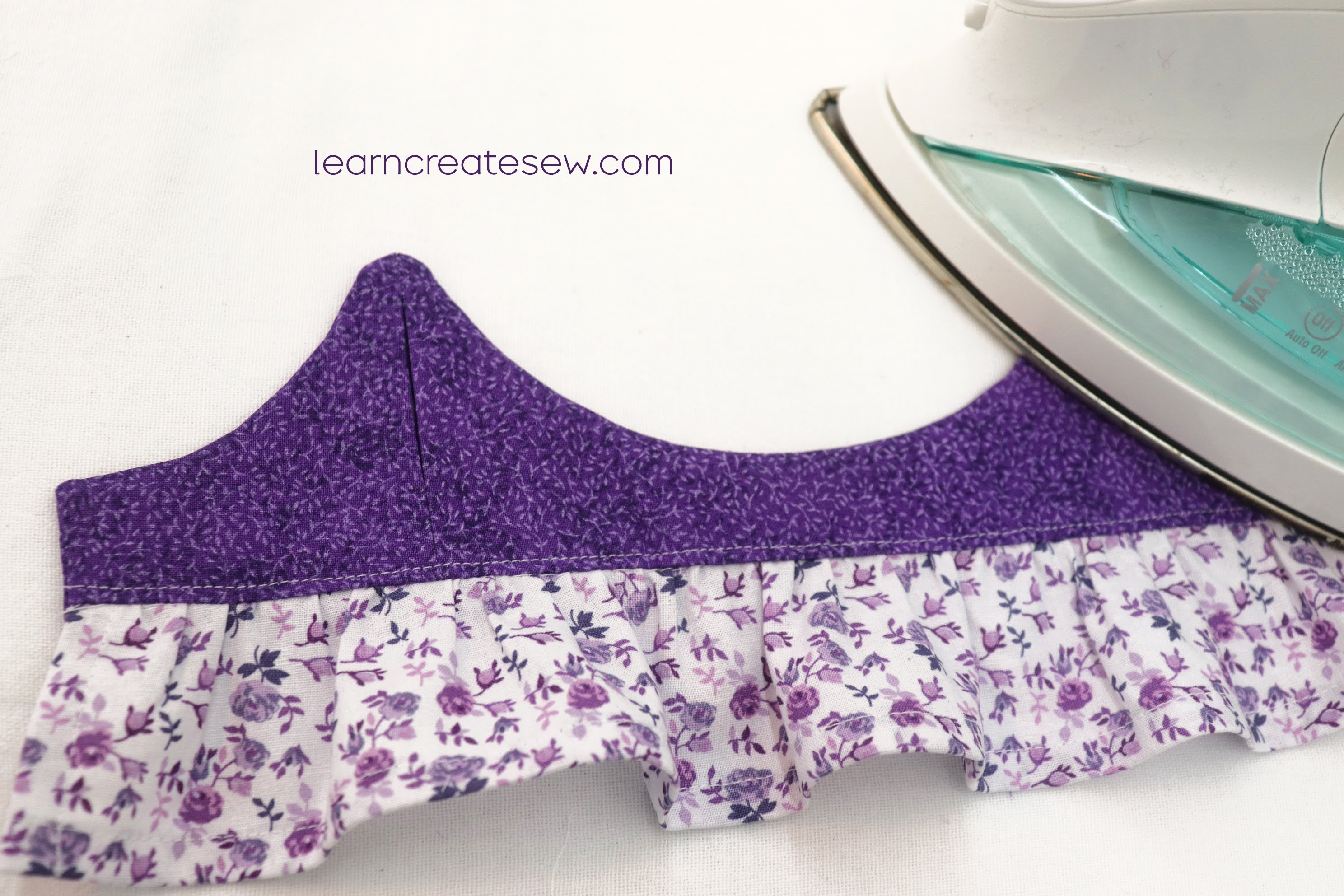
Flip the bodice right side out and press. Carefully align the bottom edge of the folded bodice so it covers the gathers and hides the seam allowance on the inside. The folded bodice edge should extend about 1/8 inch below the stitch line of the skirt. Flip it over. Pin in place as needed. From the front side, topstitch along the bottom of the bodice edge (more detailed photos below) and then press again. The skirt will now be sandwiched between the two bodice layers.
I usually topstitch with a 1/8 inch seam allowance.
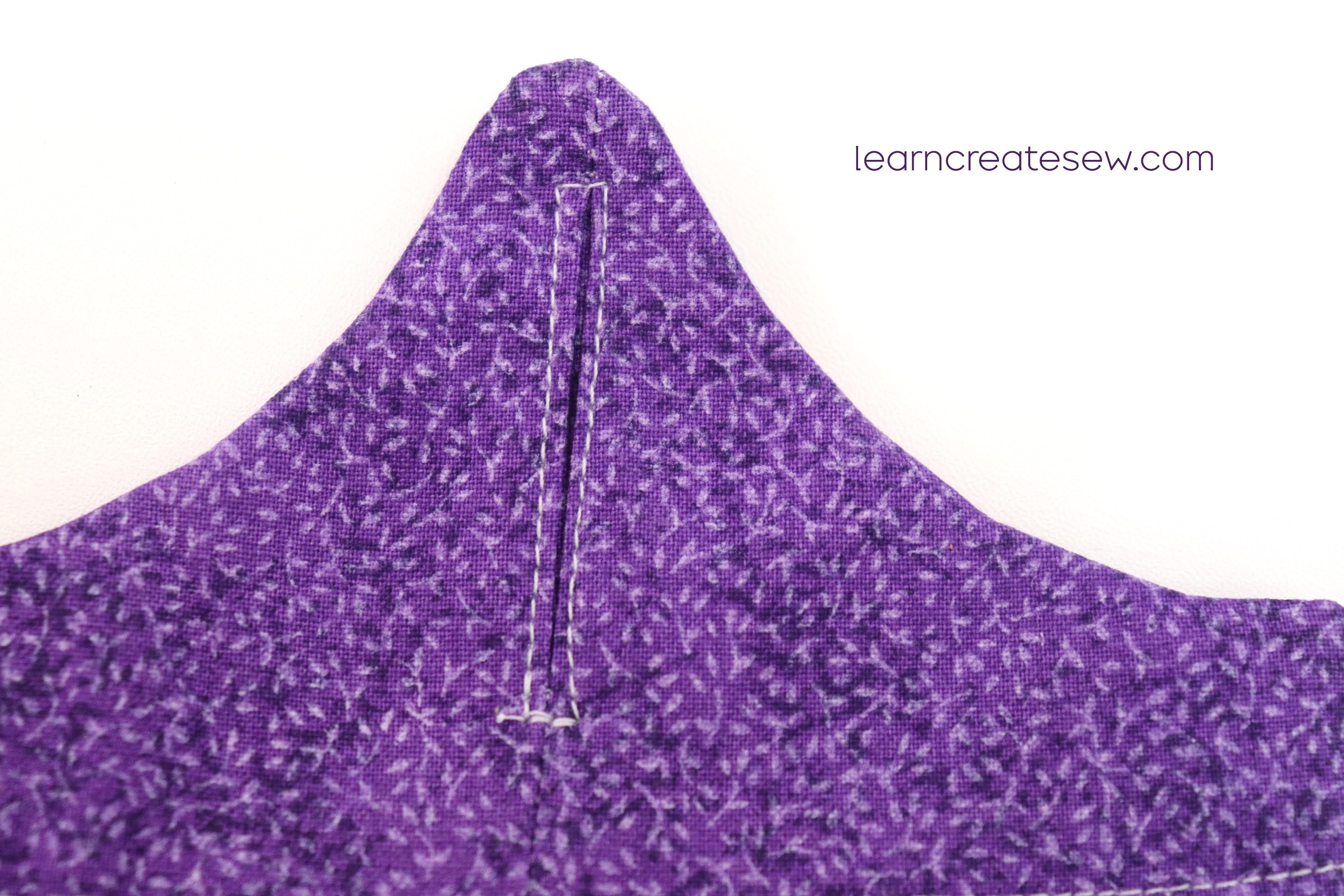
Notice there is an opening for the arm hole.
Topstitch around the slit with a 1/8 inch seam allowance.
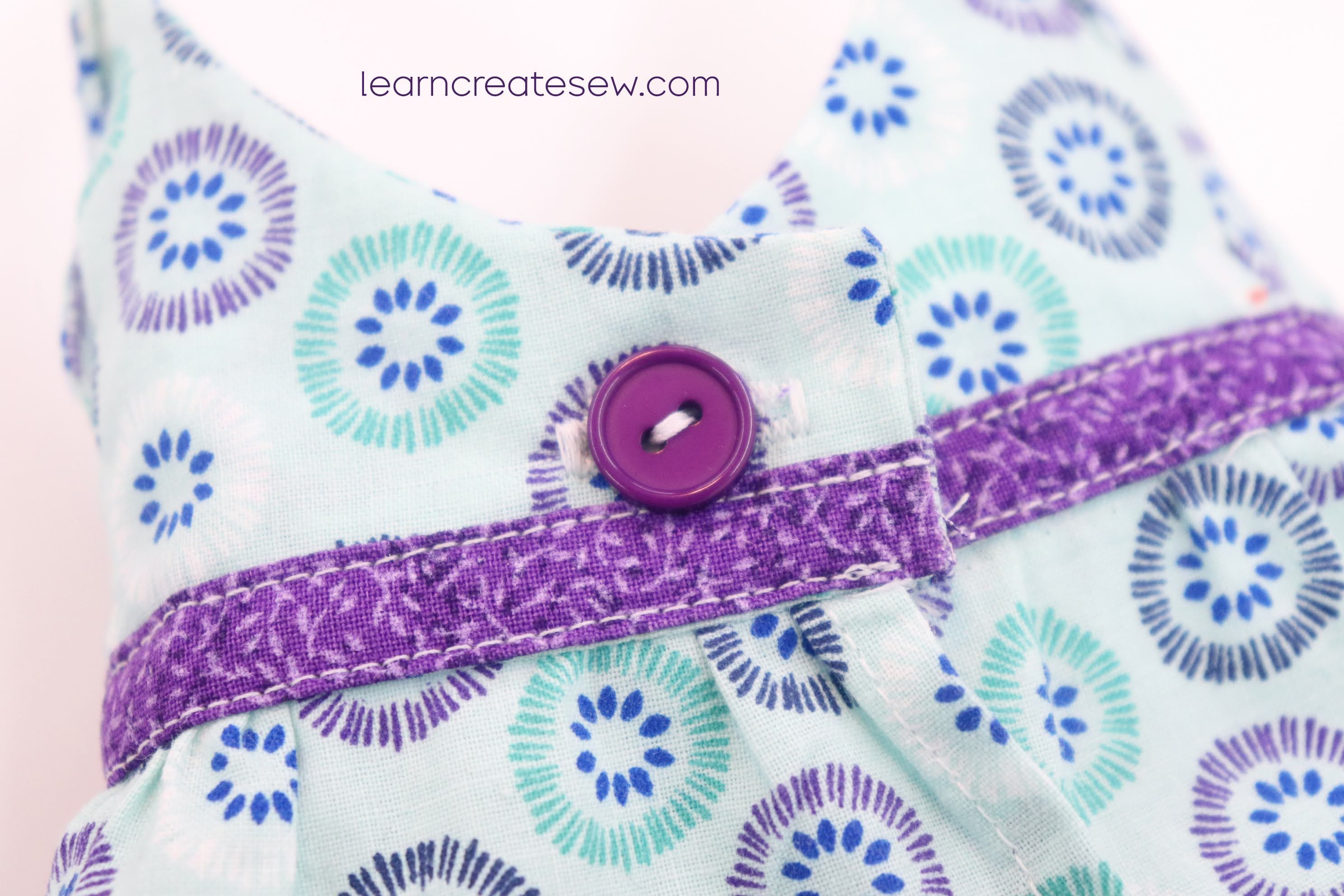
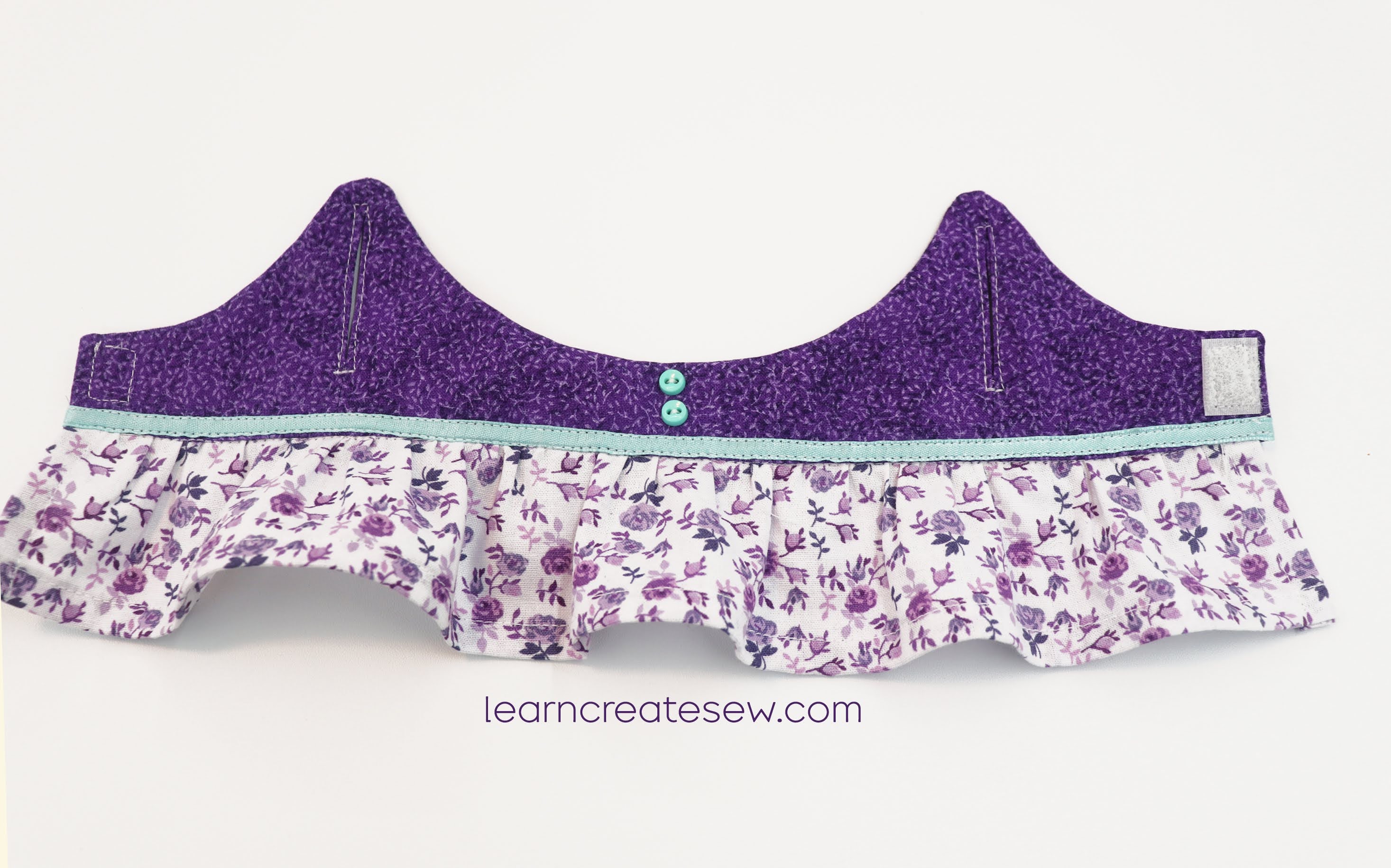
Add decorative ribbon, buttons, or trim if you like.
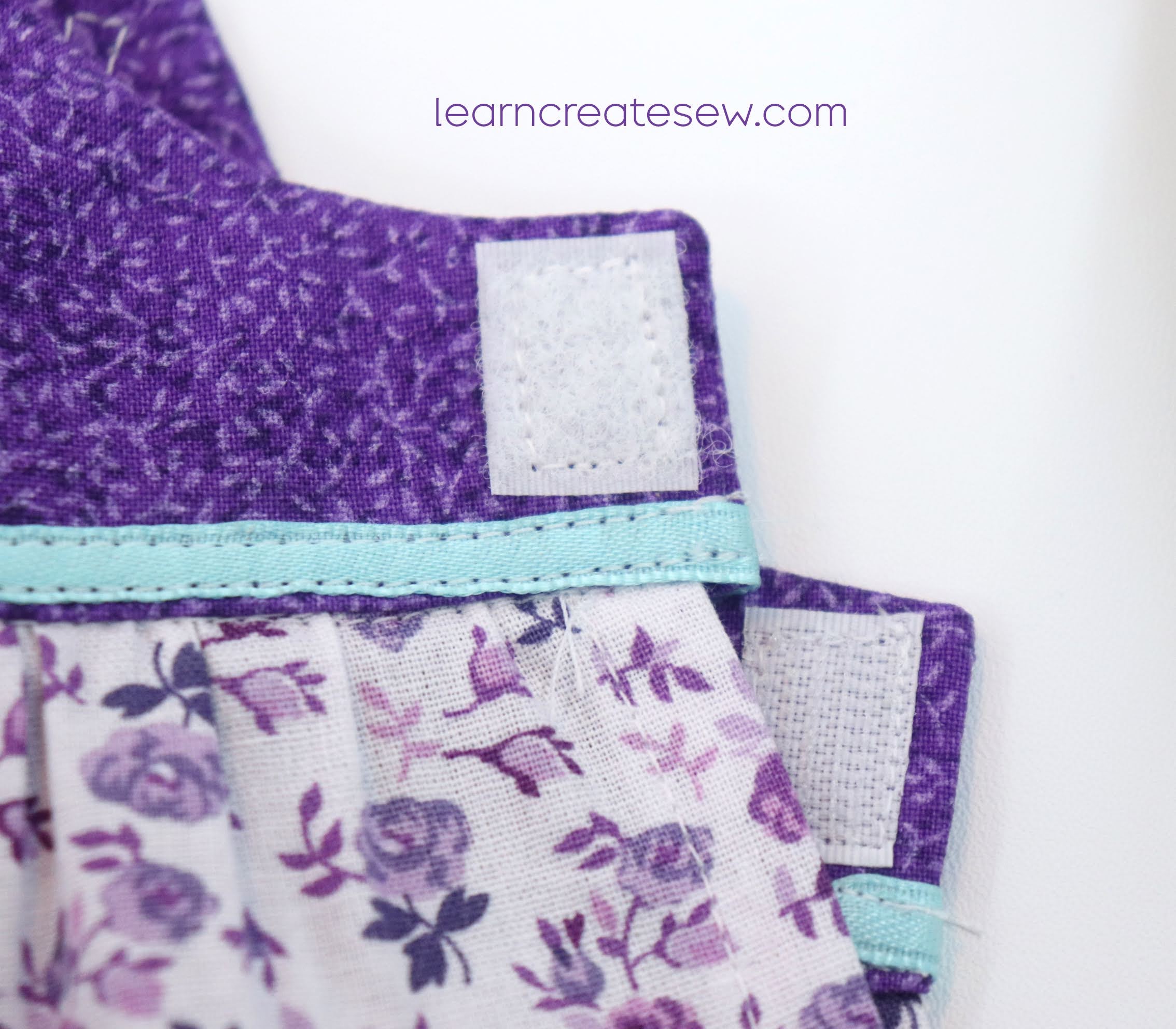
Try the dress on your sloth and then attach a closure. Velcro, buttons, and snaps all work great.
And your dress is done!
Happy Sewing!
(FYI, the shoulder seams were done differently in this picture. I still love the dress but prefer the technique described above.)
It is so nice to have the time to post projects once again! This project is here for you today thanks to a viewer request. Thanks Joanne for your idea!
This is a quick little project that is a great addition to your rag doll.
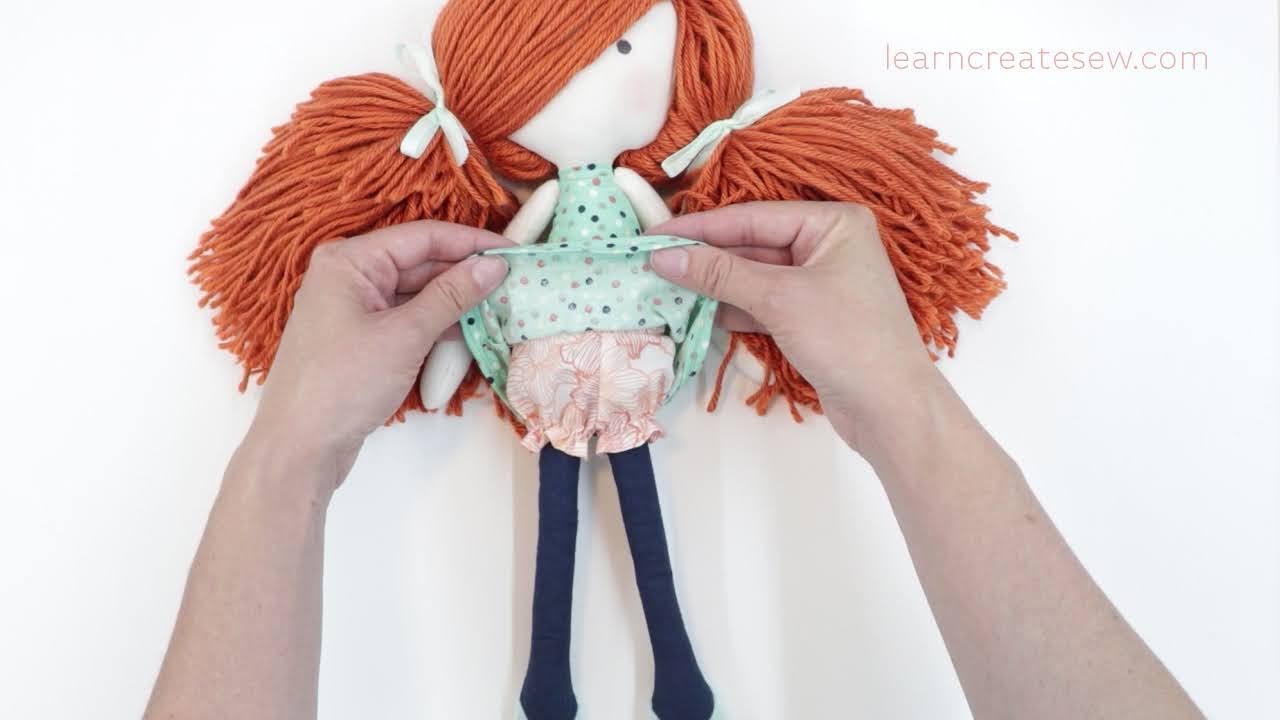
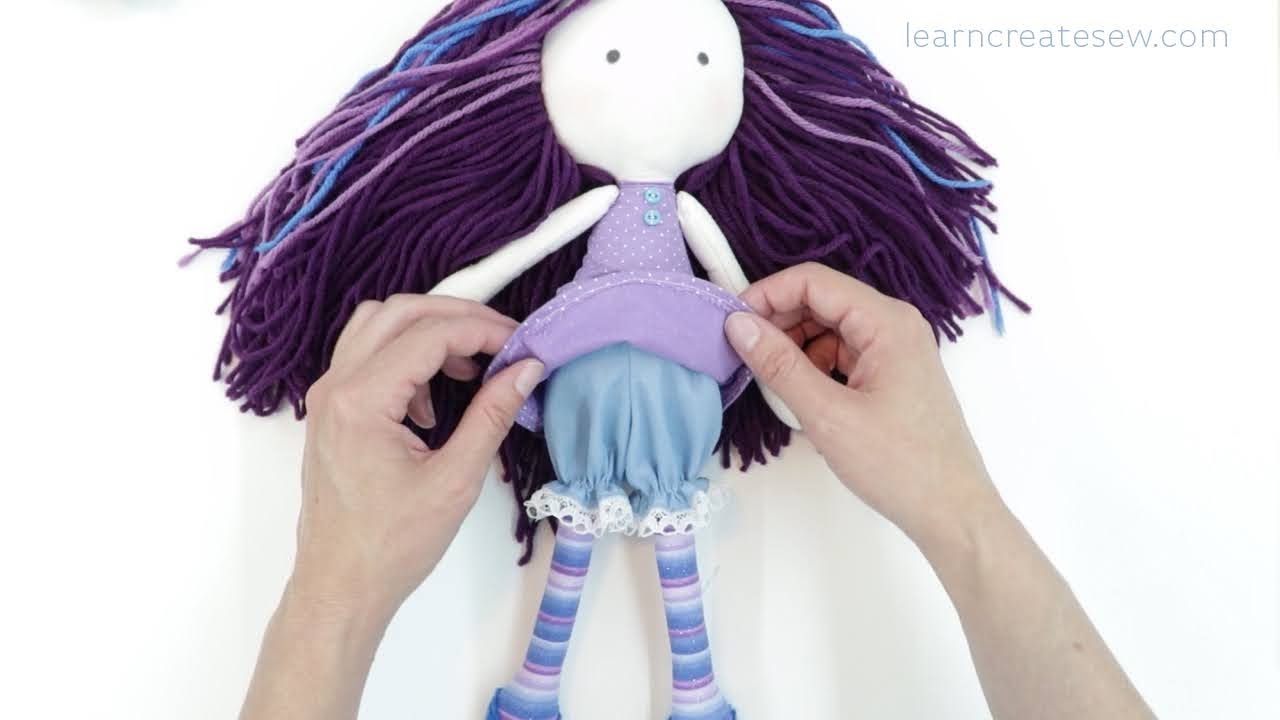
These beauties are available in 3 lengths, Short – Undies (Above) , Medium – Bloomers (Below), and Long – Extra Long Bloomers (Not Pictured).
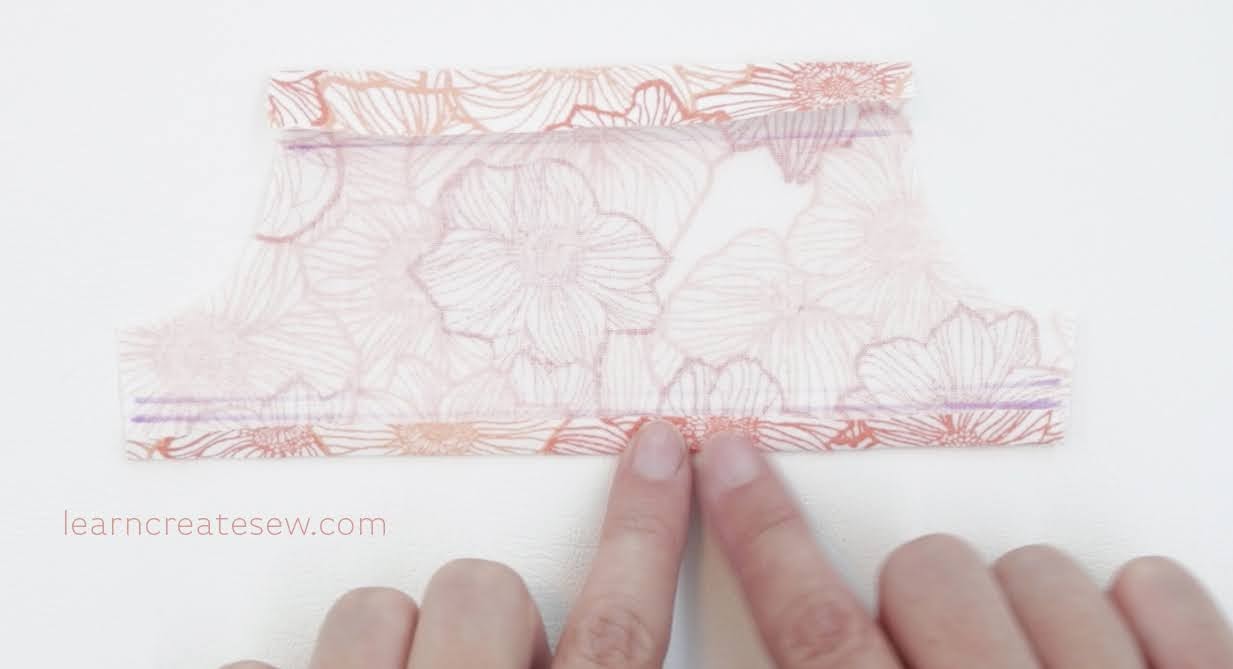
This project is pretty quick, but their tiny size does make them a challenge. As a result, I tried to make as many of the steps as possible flat.
The hems in this project are finished with a single fold. If you want to avoid fraying, you can finish the top and bottom edges with a serger. You could also use double fold hems by add 1/4 inch to the top and bottom edge of the pattern and folding over 1/4 inch before following the other directions shown in the video. This may be recommended if you plan to remove the bloomers from the doll frequently.
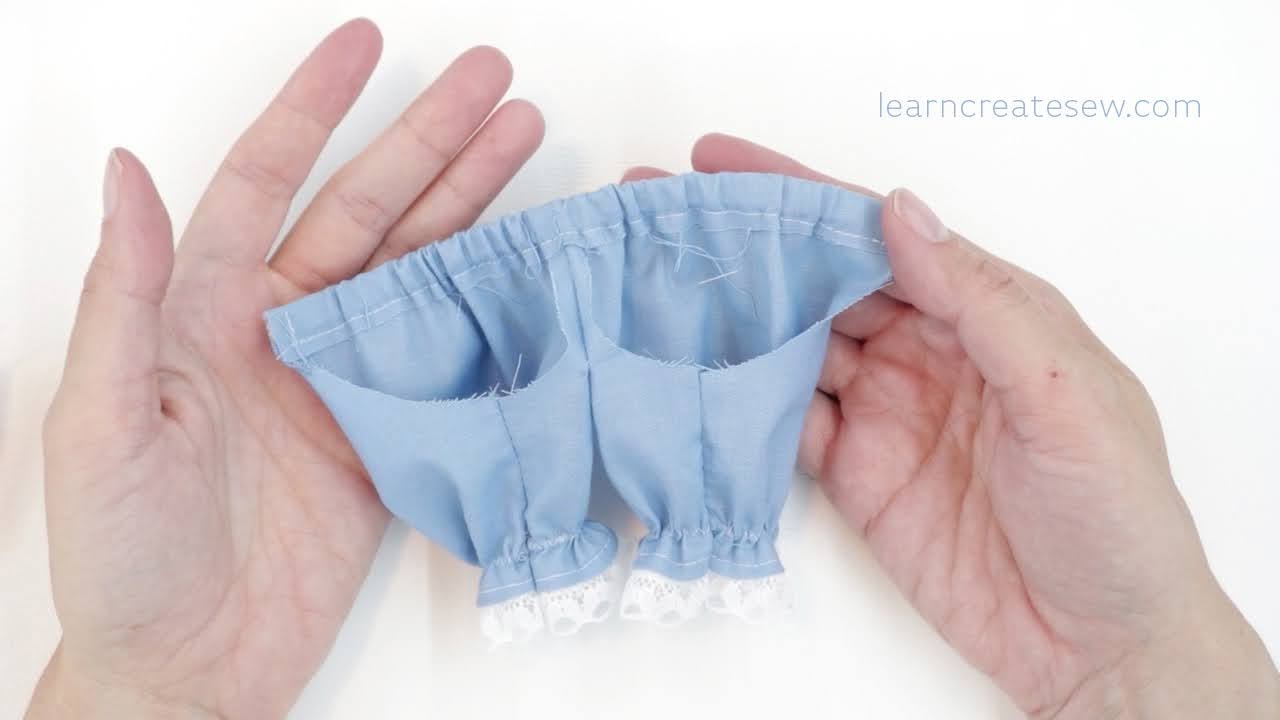
There are two waistband styles demonstrated in the video. One is constructed flat and the ends of the elastic are visible in the seam allowance. The other is constructed in the round and the elastic is completely hidden.
You can also add lace to the bottom edge to add a bit of extra cuteness 🙂
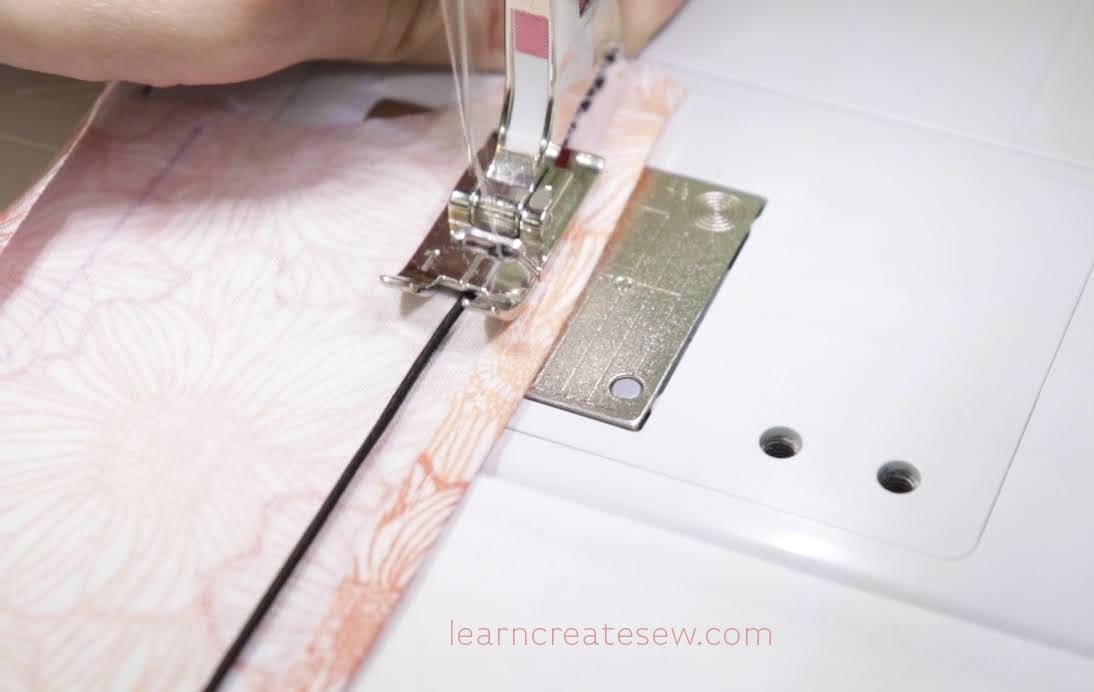
To help reduce bulk, instead of adding an elastic casing using fabric or binding, I used a zig zag stitch over narrow elastic cord. This worked very well around the teeny tiny legs of the rag doll.





































 learncreatesew